
The steps to franchising a business look straightforward on paper: file the documents, write the manual, recruit your first franchisee. Most guides make it sound like a checklist, but what they don’t tell you is that it only works if the business underneath it is actually ready to be replicated by someone who doesn’t share your instincts, your relationships, or your ten years of operational intuition.
That’s where most franchise development stories go sideways. Founders arrive at a consulting firm with a strong concept, get handed a process, and six months later realize they were handed steps without a strategy. What follows is an honest account of what the franchise development process actually involves: the infrastructure it requires, the timeline it demands, and the decisions that tend to separate systems that grow from ones that stall.
If you’d rather talk through what that would look like for your specific concept, FMS Franchise offers a free franchise feasibility questionnaire.
Why Franchising Is Harder to Start Than Most Guides Admit
Most online guides describe the steps to franchising a business as seven tidy stages. It is clean, sequential, and almost entirely unhelpful for a business owner trying to figure out whether that is even the right move.
The actual problem is not procedural. Most entrepreneurs who have built something real can follow a checklist; the harder question is whether the business has the operational depth to be replicated by someone who does not share your instincts, relationships, or knowledge. That is not a legal question; it is an organizational one, and it is the one that determines whether a franchise system produces successful franchisees or frustrated ones.
What makes franchising a serious undertaking is that you are not just creating a business expansion model. You are building a second business, one that sells the right to operate your first. That second business needs its own infrastructure with documented systems, a training architecture, a support structure, and a financial model that works for franchisees at realistic revenue levels, not just at your best-performing location.
Founders who treat franchising as a documentation exercise tend to produce franchise systems that franchisees struggle with.
What Most Guides Miss Before Step One
Answering “how do I franchise my business” correctly requires considering a prior question: Is your business ready to be franchised?
That depends on three things: whether the model is genuinely replicable, whether unit-level economics work for a franchisee, and whether you have the capacity to support a network.
Replicability is not the same as profitability
A business can be highly profitable because of its owner. Many are. The owner brings the relationships, the judgment calls, the vendor negotiations, and the culture. But none of that transfers automatically into a franchise operations manual. Before development begins, a founder needs to be able to describe, in writing, every decision a franchisee would need to make in a given week – and be confident that a capable person with proper training could make them correctly.
Unit economics need to work for someone else
Franchisees pay a royalty on top of their operating costs (typically 5-8% of gross revenue, sometimes more). If your best location runs at 18% net margin, a franchisee operating at 90% of your efficiency and paying a 6% royalty is left with a margin profile that makes the investment questionable. Running this math before development is what determines whether you are building a franchise system or a liability.
Support capacity is often the last thing founders think about
The day you have five franchisees, each with questions, compliance issues, training needs, and vendor relationships, is the day you discover whether your internal infrastructure was built to support a network or just your own operation. Most first-time franchisors underestimate this by a factor of two.
The team at FMS has worked through this readiness conversation with more than 500 franchise concepts across industries. What consistently separates the systems that launch successfully from those that stall mid-development is not the strength of the concept. It is whether the founder understood the organizational gap between owning a business and operating a franchise system before development began.
The Franchise Development Process, Step by Step
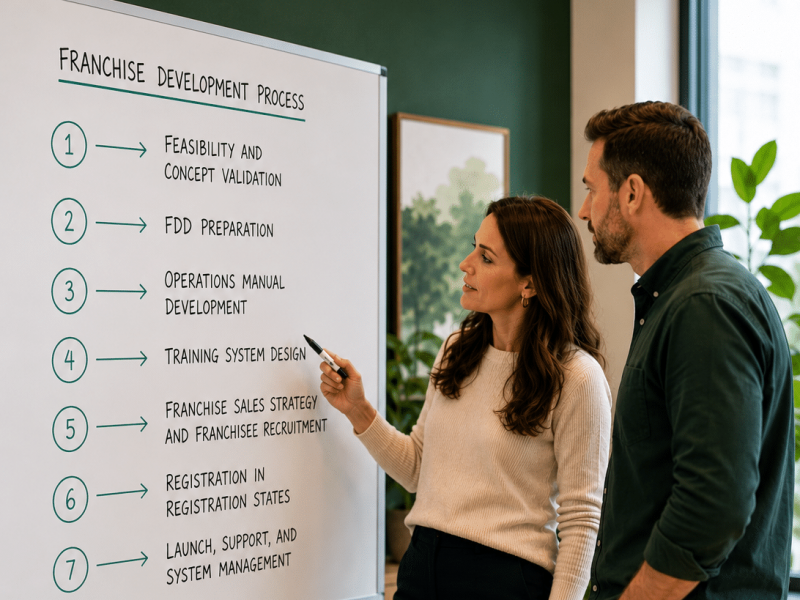
To franchise your business, you move through a structured development process that typically runs 90 to 120 days from engagement to a compliant, market-ready franchise program.
The steps to franchising a business include: a feasibility assessment, legal documentation (including the franchise disclosure document), an operations manual, a training system, a franchisee recruitment strategy, and an ongoing support framework.
Step 1: Feasibility and concept validation
Before any legal documents are drafted, a serious franchise development firm assesses whether the concept is structurally franchisable. This means evaluating unit economics, competitive positioning, replicability, and the level of founder involvement required to run the business. Feasibility work is where realistic projections are built, not as a sales exercise but as the foundation for everything that follows.
Step 2: FDD preparation
The Franchise Disclosure Document (FDD) is the legal document required by the Federal Trade Commission’s Franchise Rule. It contains 23 items covering everything from the franchisor’s background and litigation history to the estimated initial investment range and franchisee obligations. A common mistake is treating the FDD as a formality. It is not. The financial performance representations in Item 19 will be one of the first things a serious franchisee candidate reviews, and how they are presented materially affects franchise sales.
Step 3: Operations manual development
The operations manual is how your business becomes a replicable system. It documents every process, standard, and procedure a franchisee needs to operate correctly. A well-built operations manual is a practical daily guide that a new franchisee could follow from day one. Weak manuals are one of the most consistent causes of franchisee underperformance and subsequent franchisor liability.
Step 4: Training system design
Initial and ongoing training are what your operations manual becomes in practice. Most franchise systems include a combination of pre-opening classroom or virtual training, on-site opening support, and an ongoing training schedule for new products, compliance, and performance. The structure and depth of your training system directly affect franchisee success rates and, by extension, your ability to sell franchises.
Step 5: Franchise sales strategy and franchisee recruitment
This is where many first-time franchisors stall. Building a franchise program and building a franchise sales machine are two different problems. Recruiting qualified franchisee candidates requires a positioning strategy, a lead generation infrastructure, a qualification process, and a disclosure and sales process that stays within regulatory guidelines. Most founders significantly underestimate this component until they have been in the market for six months without a signed agreement.
Step 6: Registration in registration states
Fourteen states require additional registration before a franchisor can offer or sell franchises. These include California, New York, Illinois, and Maryland, among others. Registration adds time and legal cost; thus, it must be planned for if your target franchisee market includes those states.
Step 7: Launch, support, and system management
Franchising your business does not end with the first signed franchise agreement. The ongoing obligations of a franchisor include training support, brand standards enforcement, marketing coordination, and continuous system improvement. Building this infrastructure in parallel with franchise sales is what separates franchise systems that grow well from those that grow fast and break.
| Estimated franchise development costs at a glance | ||
| Component | Typical Cost Range | Notes |
|---|---|---|
| FDD and legal preparation | $15,000 – $35,000 | Franchise attorney required. Cost increases with state registration requirements and Item 19 financial performance representation complexity. |
| Operations manual and training system | $8,000 – $20,000 | Varies by concept complexity. A food and beverage concept typically runs higher than a service business with fewer documented processes. |
| Franchise development consulting | $25,000 – $75,000+ | Full-service development versus documents-only vendors. Scope and deliverables should be defined in writing before engagement begins. |
| Franchise sales and marketing | $10,000 – $40,000+ | Year-one estimate. Includes franchise portal listings, lead generation infrastructure, and broker network access where applicable. |
| Total estimated range | $50,000 – $100,000+ | Does not include ongoing royalties, advertising fund contributions, or network marketing costs after launch. |
What the Research Says About Franchise System Longevity
The difference between franchise systems that sustain growth and those that plateau or contract is documented across a consistent body of franchise industry research.
A study published by the International Franchise Association found that franchisee profitability is the single strongest predictor of franchise system growth. Systems where franchisees achieve target returns within 24 months grow their unit counts significantly faster than those where franchisee returns lag projections. This is not counterintuitive, but it has a specific implication for development: the financial model you present to franchisee candidates must be defensible, not optimistic.
What FMS’s development team consistently finds is that the systems that underperform their initial projections share a common pattern: the founder’s assumptions about franchisee capability were more optimistic than the training and support infrastructure warranted. Strong concepts under-supported by weak systems produce franchisees who blame the system. Appropriately supported franchisees in average concepts regularly outperform expectations.
For a founder evaluating franchising my business, the practical takeaway from the research is this: the investment in documentation, training architecture, and franchisee support infrastructure is not overhead. It is the product. Franchisees are not buying your logo; they are buying the probability that following your system will produce the outcome you described.
What a Thoughtful Franchise Development Approach Actually Looks Like
The difference between a franchise development firm and a franchise documents vendor is not always obvious from the outside. Most first-time franchisors only discover the difference six months after signing an engagement, when they have a completed FDD and no strategy for what comes next.
FMS Franchise operates as a full-service franchise development partner across the complete lifecycle: from initial feasibility assessment and franchise structuring through legal documentation, operations manual development, franchisee recruitment, and international expansion. In more than 20 years of franchise consulting experience and across more than 500 franchise concepts, the work has covered concepts in every category, from food and beverage and personal care to B2B services and technology-enabled businesses.
What that scale of experience produces is pattern recognition that a generalist consultant or a solo practitioner cannot replicate. A food franchise in its second year of development doesn’t face the same problems as a home services concept evaluating a master franchise model for international markets, and the advice that serves one often actively harms the other.
“What most founders don’t realize is that the franchise document is not the product; the system is the product. We’ve worked with enough concepts across enough categories to know that the difference between a franchise system that grows and one that stalls almost always traces back to whether the founder built the support infrastructure before the first franchisee signed, not after.” – Chris Conner, President of FMS Franchise.
The firm’s reach extends across the U.S., Canada, and more than 30 international markets, which matters most for founders who are already thinking about the steps to franchise beyond a single domestic market.
What to Do Right Now if You’re Seriously Considering This
Franchising your business is a decision that rewards deliberate preparation and punishes impatience. Here is what an owner who is serious about this should do in the next 30 days, before engaging anyone.
Document your unit economics with honesty
Pull the actual financials for your best location and your second-best location. Build a pro forma for a franchisee at 85% of your second-best performance, with a 6% royalty and a reasonable advertising fund contribution. If that franchisee clears a reasonable return on a $150,000-$300,000 investment, you have a franchisable unit model. If not, the economics need attention before the development process starts.
Identify your three most critical non-transferable processes
Every business has them. The things that work because of who you are, not what you’ve documented. These are the sections of the operations manual that will be hardest to write and most important to get right. Naming them now tells you where the development work will be most intensive.
Talk to someone who has built franchise systems at scale
Not a broker. Not a documents vendor. Someone who has done the readiness conversation with enough different concept types to give you an honest assessment of where your business actually sits on the franchisability spectrum. That conversation costs nothing and saves founders significant time and money before they commit to a development engagement.
Frequently Asked Questions
How long does it take to complete the steps to franchising a business?
Most franchise development programs run 90 to 120 days from engagement to a completed, compliant franchise program ready for market. This covers FDD preparation, operations manual development, and training system design. State registration in registration states adds four to eight weeks. Franchisee recruitment begins in parallel with, or immediately after, the launch.
How much does it cost to franchise a business?
Total initial development costs for a professionally structured franchise program vary with concept complexity, target markets, and the depth of support. Key components typically include legal fees for FDD preparation ($15,000–$35,000), operations and training documentation ($8,000–$20,000), and franchise development consulting. Franchise sales and marketing costs are ongoing and vary depending on the chosen recruitment strategy. For a clear picture of what your specific concept would require, FMS Franchise offers a free consultation.
What makes a business franchisable?
A franchisable business has three characteristics: a proven, profitable unit model that works at a location level; a system of operations that can be documented and taught; and unit economics that produce an acceptable return for a franchisee after royalties and fees. Profitability alone is not sufficient – the model must be replicable without the owner’s direct involvement.
Do I need a lawyer to franchise my business?
Yes. The franchise disclosure document is a regulated legal instrument governed by FTC rules and, in 14 states, by additional state registration requirements. It must be prepared by a franchise attorney, not a general business attorney. Errors in FDD preparation create regulatory exposure and are expensive to correct after the document has been issued to candidates.
What is a franchise disclosure document?
A franchise disclosure document (FDD) is a legally required disclosure package that every U.S. franchisor must provide to prospective franchisees at least 14 days before any agreement is signed or money is exchanged. It contains 23 items covering company background, fees, obligations, territory, training, financial performance, and franchisee obligations. It is the central legal document in the U.S. franchise system.
Can I franchise a small business?
Size is not the primary factor in franchisability. What matters is whether the concept has proven unit economics, a replicable operating model, and the financial structure to support a franchisee network. Some highly successful franchise systems started as single-location businesses with strong fundamentals. Feasibility analysis, not revenue size, is the right starting test.
What is the first step to franchising a business?
The first step is an honest feasibility assessment. Before any legal documents are prepared or development money is committed, a founder needs to evaluate whether the concept is structurally ready to be franchised – specifically, whether unit economics work for a franchisee and whether the operating model can be documented and replicated. Everything else in the franchise development process builds on that foundation.
Is franchising my business the right growth strategy?
Franchising works well for businesses with a proven unit model, replicable operations, and economics that hold up after royalties. It is not the right move for every business, and it is not the fastest path to growth. But for founders who have built something that works and want to scale without the capital burden of company-owned expansion, it is one of the most effective structures available.
How is franchising different from licensing?
Franchising and licensing both allow another party to use your brand or system, but they are fundamentally different relationships. A license grants rights to use intellectual property with minimal ongoing involvement from the licensor. Franchising provides the franchisee with a complete operating system, ongoing support, and defined brand standards – within a legally regulated framework that includes FDD requirements and franchisee protections. Franchising creates a more durable and defensible business relationship but requires significantly more infrastructure to establish correctly.
How do I become a franchisor?
You become a franchisor by building a franchise system around your existing business – starting with a feasibility assessment, then developing the legal documentation (FDD and franchise agreement), an operations manual, and a franchisee recruitment strategy. The process typically takes 90 to 120 days with an experienced franchise development firm. Costs vary depending on concept complexity, target markets, and depth of support – which is why FMS Franchise offers a free consultation to walk through exactly what your specific business would require.
Getting the Steps Right Matters More Than Getting Them Done Fast
Franchising a business is a serious organizational undertaking, not a document project. Done correctly, it produces a scalable growth platform that creates value for franchisees and builds long-term enterprise value for the franchisor. Done without the right infrastructure, it produces legal exposure, franchisee failure, and reputational damage that is difficult to recover from.
FMS Franchise has seen the full range of what works and what does not across every industry and growth stage. That depth of experience is what separates strategic franchise development from a document package.
If you’re ready to find out what the steps to franchising your business would actually look like for your concept, talk to FMS Franchise today.
About the Author:
Chris Conner, President of FMS Franchise, brings over two decades of expertise in franchise development. Formerly Vice President at Francorp, he has worked with hundreds of franchise systems, specializing in franchise marketing, strategic planning, and system management. With a BS from Miami University and an MBA from DePaul University, Chris empowers business owners in the franchising process with tailored guidance and proven strategies. Connect with him on LinkedIn.


