Franchise Registration States
and Filing Requirements
Getting Started
If you plan to sell franchises, you need to know which states regulate the offer. 14 franchise registration states require you to file your Franchise Disclosure Document and receive approval before offering a franchise, and a smaller group of filing states require a filing and fee but no approval. Every other state follows the FTC Franchise Rule only. The map below shows where each rule applies.
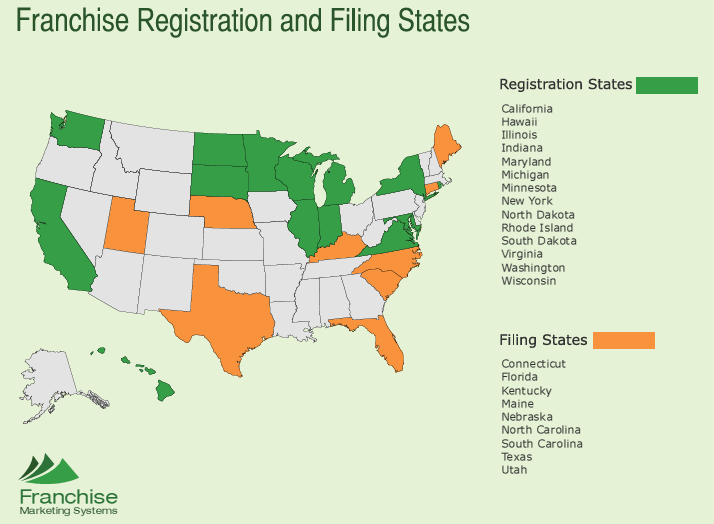
Registration and Filing States at a Glance
Franchise Registration Requirements by State
| Category | States | What it requires |
|---|---|---|
| Registration states 14 states |
California, Hawaii, Illinois, Indiana, Maryland, Michigan, Minnesota, New York, North Dakota, Rhode Island, South Dakota, Virginia, Washington, Wisconsin | ✓File the FDD and receive state approval before offering or selling. |
| Filing states 9 states |
Connecticut, Florida, Kentucky, Maine, Nebraska, North Carolina, South Carolina, Texas, Utah | ✓File and pay a fee; no approval step is required. |
| Non-registration states | All remaining states and Washington, D.C. | ✓Follow the FTC Franchise Rule and use a compliant FDD. |
CALIFORNIA
California Department of Financial Protection and Innovation 2101 Arena Boulevard, Sacramento, CA 95834
Franchise Registration Fee California $ 1,865
HAWAII
Commissioner of Securities Department of Commerce and Consumer Affairs Business Registration Division Securities Compliance Branch 335 Merchant Street, Room 203, Honolulu, HA 96813
Franchise Registration Fee Hawaii $ 250
ILLINOIS
Franchise Division Office of Attorney General 500 South Second Street
Franchise Registration Fee Illinois $ 500
INDIANA
Franchise Division Office of Secretary of State 302 W. Washington St., Rm. E111 Indianapolis, IN 46204
Franchise Registration Fee Indiana $ 500
MARYLAND
Office of the Attorney General Division of Securities 200 St Paul Place Baltimore, Maryland21202-2020
Franchise Registration Fee Maryland $ 500
MICHIGAN
Michigan Attorney General’s Office
Consumer Protection Division
Attn: Franchise Section
525 W. Ottawa Street
Williams Building, 1st Floor
Lansing, MI 48933
Franchise Registration Fee Michigan $ 250
MINNESOTA
Minnesota Department of Commerce
Securities Unit
85 7thPlace East, Suite 280
St. Paul, MN 55101-2198
Franchise Registration Fee Minnesota $ 400
NORTH DAKOTA
North Dakota Securities Department
600 East Boulevard Ave., State Capital Fifth Floor, Dept. 414
Bismarck, ND 58505-0510
Franchise Registration Fee North Dakota $ 250
NEW YORK
New York State Department of Law
Investor Protection Bureau
28 Liberty Street, 21st Floor
New York, NY 10005
Franchise Registration Fee New York $ 750
RHODE ISLAND
Franchise Office Division of Securities John O. Pastore Office Complex 1511 Pontiac Avenue, Bldg. 69-1 Cranston, RI 02910
Registration Fee Rhode Island $ 600
SOUTH DAKOTA
Department of Labor and Regulation
Division of Insurance
Securities Regulation
124 S. Euclid Suite 104
Pierre, SD 57501
Registration Fee South Dakota $ 250
VIRGINIA
State Corporation Commission Division of Securities and Retail Franchising 1300 E. Main St. 9th Floor Richmond, VA 23219
Registration Fee Virginia $ 500
WASHINGTON (STATE)
Department of Financial Institutions
Securities Division
150 Israel Rd SW
Tumwater, WA 98501
Registration Fee Washington $ 600
WISCONSIN
Department of Financial Institutions Division of Securities 345 West Washington Ave., 4th Floor Madison, WI 53703
Registration Fee Wisconsin $ 400
Part 436 sets forth those amendments to the Franchise Rule pertaining to the offer and sale of franchises.
Part 437 sets forth a revised form of the original Franchise Rule pertaining solely to the offer and sale of business opportunities.
NON-REGISTRATION STATES
The following States do not require filing or registration to be able to sell Franchises in the State. They only require that the Franchisor follow the FTC Guidelines and have an approved FDD.
- Alabama
- Alaska
- Arizona
- Arkansas
- Colorado
- Delaware
- District of Columbia
- Georgia
- Idaho
- Iowa
- Kansas
- Louisiana
- Massachusetts
- Mississippi
- Missouri
- Montana
- Nevada
- New Hampshire
- New Jersey
- New Mexico
- Ohio
- Oklahoma
- Pennsylvania
- Tennessee
- Vermont
- West Virginia
- Wyoming
FILING STATES
A Filing State is one that requires the Franchisor to file and pay a fee, but does not require the Franchisor to submit documents and seek approval to sell Franchises, like a registration State.
- Connecticut is a Franchise Filing State and has a franchise filing fee of $400.
- Florida is a Franchise Filing State and has a franchise filing fee of $100.
- Kentucky is a Franchise Filing State and has a franchise filing fee of $0.
- Maine is a Franchise Filing State and has a filing fee of $25.
- Nebraska is a Franchise Filing State and has a filing fee of $100.
- North Carolina is a Franchise Filing State and has a filing fee of $250.
- South Carolina is a Franchise Filing State and has a filing fee of $100.
- Texas is a Franchise Filing State and has a filing fee of $25.
- Utah is a Franchise Filing State and has a filing fee of $100.
Registration States Versus Filing States
A registration state and a filing state are not the same obligation, and treating them alike is how founders get tripped up. A registration state requires you to submit your Franchise Disclosure Document to a state regulator and wait for approval before you can legally offer or sell a franchise there. A filing state requires you to file and pay a fee, but you do not wait for approval to begin selling.
The distinction controls your launch timeline. Approval in a registration state can take weeks, so the states you plan to enter first should shape when you file. What FMS’s team consistently finds is that founders pick a launch market without checking whether it is a registration state, then lose a quarter waiting on approval they could have started earlier.
One nuance worth confirming with counsel: some filing states only treat you as a filing state if your primary trademark is federally registered with the USPTO. Without that registration, several of those states can require full FDD registration instead. That single fact can change your entire state map.
If you want help sequencing which states to register in first, FMS Franchise can map it to your growth plan through its franchise development services.
How to Register Your FDD Before Selling
Registering to sell franchises follows a sequence, and each step gates the next. First, you need a completed, FTC-compliant Franchise Disclosure Document, since every state builds on it. Second, you file that FDD in each registration state you intend to enter and pay the state fee. Third, you wait for the state’s review and any comments, then respond until the state clears you to sell. Only then can you make an offer in that state.
Two rules apply everywhere, registration state or not. You must provide the FDD to a prospect at least 14 days before they sign anything or pay you. And you must update the FDD annually, which means your state registrations renew on that same cycle. Budgeting for those renewals is part of the real cost of selling across state lines.
Getting the order right is the difference between a clean launch and a stalled one, which is exactly the kind of planning a first conversation covers. FMS Franchise offers a free franchise consultation to walk owners through it.
Frequently Asked Questions
How many franchise registration states are there?
There are 14 franchise registration states that require you to file your Franchise Disclosure Document and receive approval before offering a franchise: California, Hawaii, Illinois, Indiana, Maryland, Michigan, Minnesota, New York, North Dakota, Rhode Island, South Dakota, Virginia, Washington, and Wisconsin.
What is the difference between a registration state and a filing state?
A registration state requires you to submit your FDD and get state approval before selling. A filing state requires only a filing and a fee, with no approval step. Both differ from non-registration states, which require only that you follow the FTC Franchise Rule with a compliant FDD.
How much does franchise state registration cost?
State registration fees are charged per state and vary widely, so your total depends on how many states you enter. The individual fees are listed by state above. Budget the state fees on top of the one-time cost of developing your FDD and its annual updates.
How long does franchise registration take?
Timelines vary by state and by how complete your FDD is when you file. Registration states review your document and may return comments before clearing you to sell, which can add weeks. Filing states are faster because there is no approval step. Plan your launch markets around the states with the longest review.
Do I have to register in every state?
No. You register or file only in the states where you intend to offer or sell franchises. Many franchisors start in a few target markets and add states as they grow. Non-registration states require no filing, only a compliant FDD and adherence to the FTC Franchise Rule.
Registration is less about paperwork and more about sequence: a compliant FDD first, then the right states in the right order, then approval before you sell. Handled that way, franchise registration states become a launch schedule you control rather than a surprise that delays you. FMS Franchise has worked with more than 1,500 franchise concepts, so the state plan you build is grounded in how systems actually roll out.
If you want your state registration mapped to your growth plan before you file, the next step is a conversation with FMS Franchise, which offers a free franchise consultation for owners preparing to sell: https://www.fmsfranchise.com/franchise-your-business/.