
Most business owners who ask, “How do I franchise my business?” already know their concept works. They’ve built something repeatable, their customers keep coming back, and they’ve probably had someone say, “You should open more of these.”
At this point, the question isn’t really about whether scaling is possible. It’s about whether the path from here to a functioning franchise system is something they can actually survive with their business intact. This guide answers that question directly. If you’d rather talk through what franchising would look like for your specific business, FMS Franchise offers a free franchise consultation.
Why Most Business Owners Wait Too Long to Ask This Question
Franchising has a reputation problem. The word conjures either a massive fast-food empire or a low-margin licensing deal where someone else waters down your brand. Neither image accurately reflects the business owners who are actually good candidates for franchising, and neither shows what happens when the process is done correctly.
What actually delays most founders isn’t fear of the process; it’s a vague sense that their business isn’t “ready yet” – that there’s some threshold of size, revenue, or operational polish they need to hit before franchising becomes a real conversation. But that threshold doesn’t exactly look like how founders imagine it.
The real readiness question is simpler: can someone else run your business at the same quality level, following a documented system, without you standing over their shoulder every day? If the answer is yes (or close to yes), the conversation about how to franchise your business is probably worth having sooner than you think.
FMS has worked with more than 500 franchise concepts across industries, and the businesses that wait longest tend to share one trait: they conflate “building the business” with “building the franchise system,” as if the two happen automatically together. They don’t. The franchise system is a separate thing you build once, correctly, at the right moment (rarely as far off as founders assume).
The consequences of waiting too long are real. Competitors who started franchising 18 months ago are now 15 locations ahead of you in markets you could have owned. Key employees you could have converted into franchisees move on. And the window in which your concept has a clear category advantage starts narrowing.
None of that is meant to create urgency for urgency’s sake. It’s the realistic context for a decision that deserves to be made clearly.
What Franchising Actually Requires Before You Start
Franchising is a legal, operational, and sales infrastructure you build to support other people running copies of your business. That distinction matters because it shapes what the process costs, how long it takes, and what has to exist before you spend a dollar on development.
Does your business model pass the replication test?
Before exploring the steps to franchise a business, three conditions need to be true.
First, your concept must be teachable. A new franchisee with a relevant background but no direct experience in your specific method should be able to learn the system from documented training, not from watching you personally.
Second, the economics need to work for someone who is paying a royalty. If your unit-level margins are thin enough that adding a royalty payment (typically 5%-8% of gross revenue) would push a franchisee into marginal territory, the model needs to be stress-tested before you franchise it.
Third, the concept needs to be differentiated enough to attract the ideal franchisee in a competitive market. There are thousands of franchise opportunities. Yours competes with all of them.
If all these conditions are true, or close to true with minor refinements, you are almost certainly further along than you think.
Why the legal infrastructure is non-negotiable
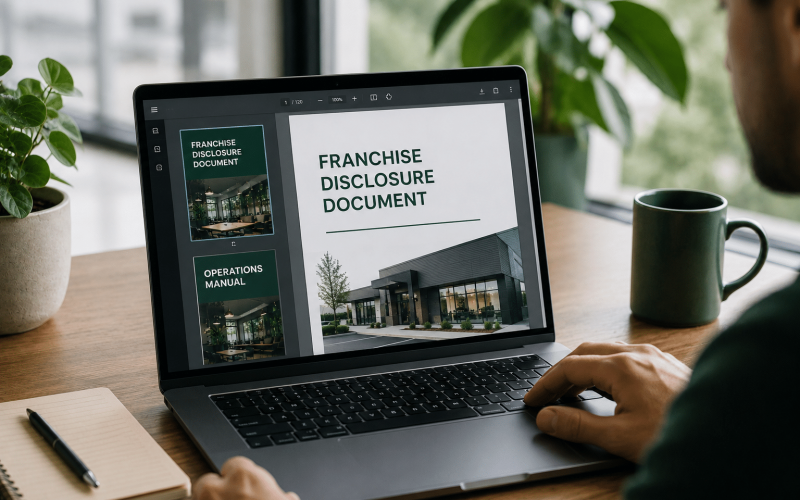
Franchising in the United States is regulated at both the federal and state levels. The Federal Trade Commission requires franchisors to provide a Franchise Disclosure Document (FDD) to prospective franchisees at least 14 days before any agreement is signed or any money changes hands. The FDD is a legally standardized document covering 23 specific items, including the franchisor’s background, fees, territorial rights, financial performance representations, and the full franchise agreement itself.
Several states impose additional requirements beyond the FTC rule, including registration of the FDD before you can legally sell franchises there. This is not meant to be alarming. It is the factual landscape every franchisor operates in. FMS’s franchise development process accounts for this from the beginning, building the legal documentation alongside the operational infrastructure rather than treating them as separate phases. After more than 20 years of franchise consulting experience, the firm’s approach is designed around the reality that legal compliance and operational readiness are not sequential problems.
The Real Steps to Franchise a Business
Here is how the full development process maps to realistic timelines. The ranges reflect what FMS Franchise consistently sees across concept types; service-based businesses without physical build-out requirements tend to run toward the shorter end.
Franchise Development Timeline
Typical phases and durations from signing to first franchisee opening
| Phase | What Happens | Typical Duration |
|---|---|---|
| Feasibility Assessment | Unit economics review, market analysis, replication assessment, go/no-go recommendation | 2–3 weeks |
| Operations Documentation | Franchise operations manual, training program design, technology and vendor systems | 4–6 weeks |
| Legal Documentation | FDD preparation, franchise agreement drafting, state registration filings where required | 6–10 weeks, concurrent with above |
| Franchise Sales Launch | Franchisee recruitment strategy, lead generation, candidate qualification process | Begins at FDD completion |
| First Franchisee Onboarding | Training delivery, pre-opening support, launch-period field support | 4–8 weeks post-signing |
| First Franchisee Opens | Site-dependent for physical concepts; faster for service-based models | 120–180 days from franchisee signing |
| Total: Signing to First Franchisee Offering | Full-service engagement with an experienced development partner | 90–120 days |
Step 1: Feasibility assessment
Before any development work begins, a serious franchise development partner should tell you whether franchising makes sense for your specific concept. Not every business should franchise, as some have unit economics that don’t support a royalty structure, and others have owner-dependent elements that can’t be systematized without fundamentally changing what makes the concept good. A proper feasibility assessment looks at unit-level economics, market size, competitive landscape, and the replication profile of the business model.
Step 2: Operations documentation and systems development
This is the work most founders underestimate. Your franchise operations manual is not a summary of how you run the business. It is the complete, documented system that another person uses to run it without you. It covers hiring protocols, quality standards, vendor relationships, technology stack, customer experience scripts, financial benchmarks, and the escalation paths for every common problem a franchisee will encounter.
For businesses running primarily on institutional knowledge and the founder’s judgment, this phase is often revelatory. The act of writing the manual surfaces the assumptions embedded in the operation, and surfacing them is what makes the system transferable.
Step 3: Legal documentation
The FDD and the franchise agreement are developed in parallel with the operations work, not after it. Franchise attorneys with specific experience are not the same as general business attorneys. This is a specialized legal area, and the quality of the initial documents has lasting consequences. Poorly drafted territorial rights provisions, for example, create disputes that are expensive to resolve and damaging to franchisee relationships.
Step 4: Franchise sales and franchisee recruitment
Finding the right franchisees is not a volume exercise. It is a qualification exercise. The franchisees who are most likely to succeed in your system are not the ones who are most enthusiastic about the brand. They are the ones whose background, capital position, operational capacity, and local market give them the highest probability of executing the model correctly.
A franchise sales process built around that standard produces better franchisees, lower franchisee failure rates, and a stronger network effect as the system grows.
Step 5: Franchisee onboarding and launch support
The first 90 days of a franchisee’s operation are the highest-risk period in the franchise relationship. A well-designed onboarding system includes initial training, on-site support during the pre-opening and early-operation phase, and a structured check-in cadence that identifies problems before they compound. Franchisors who treat post-sale support as a secondary concern tend to learn why it matters through franchisee attrition.
What Actually Happens Between “Yes, I Want to Franchise” and Your First Franchisee Opening
The process from signed development agreement to first franchisee opening typically runs 90-180 days for a well-prepared concept with an experienced development partner. Here is what that time actually looks like.
In the first 30 days, the work is almost entirely internal. You are in feasibility discussions, providing financial records, submitting to competitive analysis, and beginning the process of articulating your operating system on paper. Most founders describe this phase as either clarifying or humbling, depending on how much of their operation exists in their heads versus in documented form.
Days 30-90 are when the parallel tracks of legal documentation and operations development run simultaneously. You are reviewing FDD drafts, working through the operations manual section by section, and making decisions about the franchise system structure: royalty rates, territory definitions, training program design, technology requirements, and the profile of the franchisee you are trying to attract.
By day 90-120, the FDD is in final review with franchise legal counsel. The operations manual is substantially complete. You have a franchise sales strategy and a target franchisee profile. In states requiring franchise registration, that process is running in parallel. In non-registration states, you can begin franchise sales once the FDD is complete.
The first franchisee opens somewhere between 120 and 180 days after your first signed franchisee, depending on site selection, lease negotiation, construction or build-out timelines, and how quickly your training program can be delivered. For service-based businesses without physical build-out requirements, that timeline compresses significantly.
This is a compressed, honest version of the timeline. Real complications occur, and experienced franchise consultants anticipate them because they have seen the same pressure points across hundreds of system launches. What clients who delay this decision typically discover is that the complications they feared most during development are rarely the ones that actually materialize. The real friction is usually in territory design or franchisee qualification, where decisions made early create constraints later.
“The founders who struggle most during franchise development aren’t the ones with imperfect systems. They’re the ones who assumed their business was simpler to document than it turned out to be. The operations manual process is where the real work happens, and it’s almost always more valuable than the founders expect – not just for franchising, but for how they run the original business afterward.” – Chris Conner, President of FMS Franchise.
What Franchising Your Business Actually Costs
This is the question most founders ask first and get the vaguest answers about. The honest range is wide because the inputs are variable.
What to Look for in a Franchise Development Partner
The franchise consulting industry is not regulated, which means anyone can call themselves a franchise consultant. The quality range is enormous, and selecting the wrong development partner is one of the most expensive mistakes a franchisor can make.
Here is a practical framework for evaluating firms:
A development partner should have documented experience building complete franchise systems, not just connecting buyers and sellers. Franchise brokers and franchise development firms do very different things: brokers earn a commission for placing franchisees into existing systems, while development firms build the system. FMS Franchise does the latter; it does not broker franchise deals.
The firm should be able to show you comparable franchise concepts they have developed, ideally in your industry or in adjacent industries that share operational characteristics with your business.
Ask specifically about post-sale franchisee support. What does the development firm provide? What transitions to the franchisor? What ongoing support systems are included in the development package? The answer to those questions tells you whether the firm’s business model is aligned with your long-term success or front-loaded around your initial fees.
Frequently Asked Questions About Franchising Your Business
How long does it take to franchise my business?
Most well-prepared concepts complete the development process (from initial agreement through a compliant FDD and first franchise offering) in 90 to 120 days with an experienced development partner. State registration requirements in heavily regulated markets like California and New York can extend this timeline. Service-based concepts without physical build-out requirements typically move faster.
How much does it cost to franchise my business?
Total franchise development costs typically range from $35,000 to $75,000 for an initial full-service engagement covering feasibility, operations documentation, legal documentation, and franchise sales infrastructure. Legal fees alone (FDD preparation, franchise agreement drafting, state registrations) can run $15,000 to $40,000, depending on complexity.
What is a Franchise Disclosure Document (FDD), and do I need one?
An FDD is a legally required disclosure document covering 23 standardized items that the FTC mandates be provided to prospective franchisees at least 14 days before signing or payment. It includes the franchise agreement, audited financial statements, litigation history, and fee structure. Any business offering franchises in the United States is legally required to provide a compliant FDD. Selling franchises without one is a federal and, in registration states, a state-level legal violation.
Do I need a lawyer to franchise my business?
Yes, and specifically a franchise attorney, not a general business attorney. Franchise disclosure law is a specialized field. The FDD must comply with both FTC requirements and state-specific registration requirements in 14+ states. An attorney without franchise-specific experience who drafts your FDD creates legal exposure for you that can be expensive to remediate. Most full-service franchise development firms include legal coordination as part of the development process.
How do I know if my business is ready to franchise?
Three core conditions define readiness: the business model is teachable and can be documented as a replicable system; unit-level economics support a royalty structure without pushing franchisee profitability into marginal territory; and the concept is differentiated enough to attract qualified franchisee candidates. A formal feasibility assessment with an experienced franchise consultant is the most reliable way to evaluate all three conditions honestly.
How do franchise royalties work?
Royalties are typically structured as a percentage of gross revenue paid by the franchisee to the franchisor on a weekly or monthly basis. Standard royalty rates range from 4% to 8% of gross revenue, though some service-based concepts run higher and some volume-intensive concepts run lower. Royalties are separate from the initial franchise fee paid at signing and from any required contributions to a brand-level marketing fund.
What is the difference between franchising my business and licensing it?
Licensing grants rights to use intellectual property (a brand name, a formula, a system) without the regulatory framework and ongoing relationship structure of franchising. Franchising provides the franchisee with a complete operating system, ongoing support, and defined standards, in exchange for fees and royalties, within a legally regulated framework. Franchising creates a more durable and defensible business relationship but requires significantly more infrastructure to establish correctly.
What the Right Franchise Development Looks Like in Practice
Franchising a business is not a transaction. It is the construction of a new business on top of the one you already have. Done correctly, it creates a revenue stream, a brand footprint, and a network of owner-operators with direct financial stakes in the success of your system. Done incorrectly, it creates legal liability, underperforming franchisees, and reputational damage that is difficult to reverse.
The firms best positioned to help are those that have built complete franchise systems at scale, across multiple industries, and can show the pattern recognition that comes from that experience. FMS Franchise has developed more than 500 franchise concepts across the United States and 30+ international markets, operating across every stage of franchise development, from initial feasibility through franchise sales and ongoing franchisor support. That scope is not a marketing claim. It is what makes the guidance specific rather than generic.
When you’re ready to move from “I’m thinking about franchising” to “I understand what franchising would actually require for my specific business,” the right starting point is a direct conversation with someone who has done this hundreds of times.
Schedule a free franchise consultation with FMS Franchise to get a clear, honest assessment of what franchising your business would involve.
About the Author:
Chris Conner, President of FMS Franchise, brings over two decades of expertise in franchise development. Formerly Vice President at Francorp, he has worked with hundreds of franchise systems, specializing in franchise marketing, strategic planning, and system management. With a BS from Miami University and an MBA from DePaul University, Chris empowers business owners in the franchising process with tailored guidance and proven strategies. Connect with him on LinkedIn.


