
Expanding into new locations is one of the most exciting stages of business growth. For experienced owners, that excitement comes with a healthy level of caution. After all, the question is not about the possibility of growth, but whether the next location is truly positioned to succeed.
That concern is justified. A franchise location affects everything that follows, from unit economics and staffing to marketing efficiency and long-term brand perception. Too often, these big decisions are made based on instinct, surface-level demographics, or even what “worked last time.” In today’s market, that approach carries unnecessary risk.
This is where data-driven growth changes the conversation. Instead of guessing, predictive analytics helps business owners see whether a new location truly supports sustainable franchise expansion.
If you are exploring franchising or preparing for your next location, working with experienced franchise consultant companies can help you use data the right way, without losing sight of real-world nuance. Let’s see how analytics can guide smarter franchise expansion decisions.
The Importance of Choosing the Right Franchise Location
A new location is not simply about filling space on a map. It is about positioning your brand where it can thrive, repeat success, and scale without friction. One poor location can strain systems, discourage franchisees, and slow momentum across the entire network.
Many business owners underestimate how different markets can be, even within the same state. But the truth is that customer behavior, spending patterns, competition, labor availability, and traffic flow all vary more than surface-level data suggests. A location that looks promising on paper may struggle in practice if those variables are misunderstood.
A data-driven growth strategy helps reduce that uncertainty by allowing brands to evaluate potential franchise locations using real signals instead of assumptions. Predictive analytics brings together historical data, market indicators, and forward-looking models to help business owners see what is likely to happen, not just what has happened before.
With the right guidance, choosing a franchise location becomes a strategic decision instead of a gamble.
What Is Data-Driven Growth and Predictive Analytics
At its core, it means making expansion decisions based on evidence rather than instinct alone. It’s important to note that this strategy doesn’t remove human judgment – instead, it supports it with measurable insight.
For franchise brands, this approach applies to where you expand, how fast you grow, and which markets deserve priority. Data-driven franchise decisions consider patterns in customer demand, competitive density, local economics, and performance trends across existing units.
Rather than asking, “Could this market work?” brands begin asking, “How well does the data suggest this market will do over time?”
How Predictive Analytics Supports Franchise Expansion
In the context of franchise growth, franchise data forecasting helps estimate how a new location may perform before significant investment is made.
Predictive tools for franchise growth often analyze:
- Past performance of similar locations
- Demographic trends and population movement
- Competitive saturation and brand presence
- Traffic patterns and accessibility
- Economic indicators that affect discretionary spending
The goal is not perfection; it is probability – predictive analytics helps franchise brands make decisions that are more likely to succeed than fail.
The Role of Big Data in Franchise Location Decisions
Big data has changed how franchise expansion works. Information that once required months of manual research is now available through advanced analytics platforms. Location intelligence for franchises allows brands to evaluate hundreds of markets efficiently, narrowing focus to those with the strongest alignment.
Still, data on its own does not make decisions. It becomes valuable only when it is applied to real expansion questions, which is where predictive analytics begins to shape how franchise locations are evaluated.
The Benefits of Using Predictive Analytics to Choose Your Franchise Location
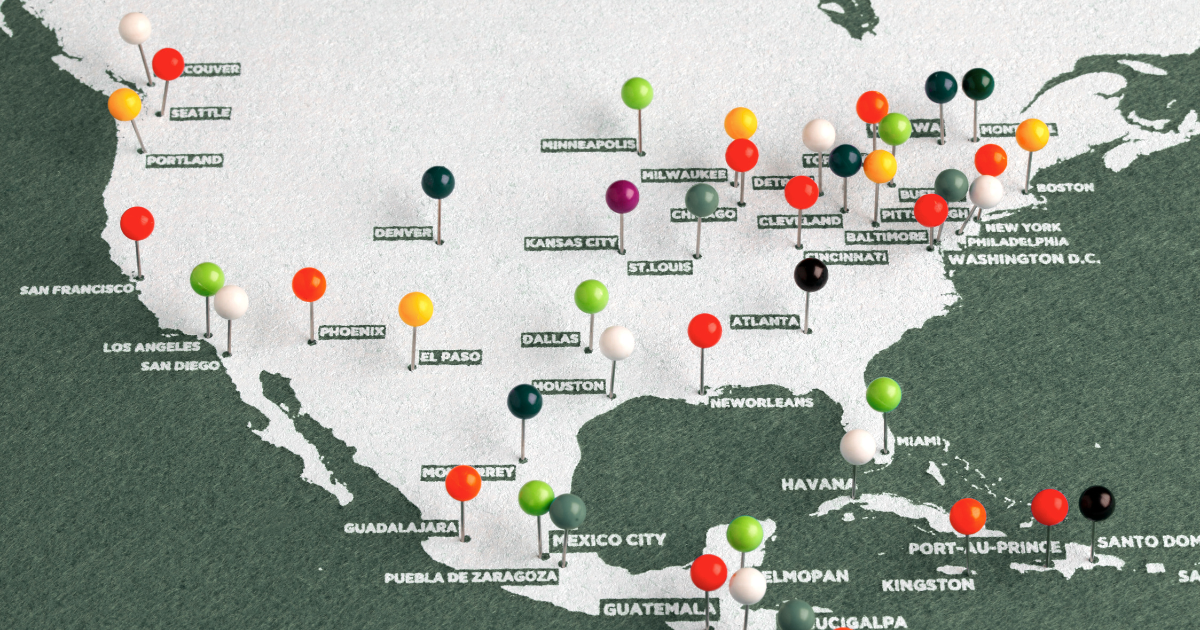
Choosing a franchise location becomes far less uncertain when decisions are guided by data that shows how a market is likely to perform, not just how it looks today. This kind of insight is especially important for brands building scalable franchise plans, where each new location needs to support consistent growth across the system.
Minimizing Risk and Uncertainty
One of the greatest benefits of predictive analytics is risk reduction. Franchise expansion involves capital, time, and reputation, so choosing the wrong location affects not only one unit, but confidence across the entire system.
By using analytics, brands can identify warning signs early: low demand, oversaturated competition, or economic instability become visible before commitments are made. This allows franchisors to redirect resources toward markets with stronger fundamentals.
Identifying High-Demand Markets
Predictive analytics helps uncover markets that may not appear obvious at first glance. Emerging suburbs, growing secondary cities, and underserved communities often present strong opportunities for franchise growth.
Using analytics for franchise location planning allows brands to identify where customer demand aligns with their offering, rather than relying solely on population size or general income levels.
Supporting Long-Term Scalability
Sustainable growth requires more than short-term wins, and data-driven insights help brands assess whether a market can support multiple locations over time, whether franchisees can recruit effectively, and whether operational systems can scale.
For franchisors thinking beyond their next opening, data-driven growth supports expansion that builds momentum instead of fragmentation.
How Predictive Analytics Helps Plan Your Next Franchise Location
The effectiveness of predictive analytics depends on data quality. Franchise expansion models rely on accurate, current, and relevant inputs. This includes internal brand performance data as well as external market data.
Franchise professionals help ensure that the right data sources are used and that conclusions are grounded in reality, not theory. Without this oversight, brands risk drawing confident conclusions from incomplete information.
Key Metrics Used in Franchise Location Models
Predictive models often evaluate a combination of quantitative and qualitative factors, including:
- Population density and growth trends
- Household income and spending behavior
- Competitive landscape and brand overlap
- Traffic flow and visibility
- Labor market conditions
- Real estate availability and cost
Each metric alone tells an incomplete story, but together, they provide a clearer picture of how a franchise location may perform.
Real-World Expansion Scenarios
Consider a brand preparing to expand beyond its original region. In franchise planning work for brands like Gong Cha, early discussions often focus on major metro areas because of population size and visibility. But when predictive analytics are applied, a different picture can emerge – some large markets show signs of saturation, while nearby secondary cities reveal stronger demand and more room to grow.
In these situations, data insights for franchise expansion help brands choose locations that support steady growth, rather than expanding too quickly into crowded markets.
Identifying the right markets is only part of the process. Turning these insights into a clear, repeatable expansion plan often requires experience, structure, and the right guidance.

The Role of Franchise Consultant Companies in Data-Driven Expansion
In the end, analytics tools do not replace experience. Franchise consultants bridge the gap between data and decision-making. They help brands ask the right questions, interpret results accurately, and apply insights within the context of franchise operations. They also bring perspective that data alone cannot provide, such as understanding franchisee behavior, territory planning, and brand positioning.
The Value of Expert Interpretation
Predictive analytics can highlight trends, but it cannot fully account for local nuances or brand-specific variables. Experienced professionals help brands recognize when data signals opportunity and when it requires caution.
This balance is especially important for emerging franchisors who are still refining systems and support structures.
Why FMS Franchise Plays a Strategic Role
We integrate predictive insights with franchise development expertise. Rather than offering data in isolation, FMS helps brands align location strategy with legal structure, operational readiness, and long-term growth goals.
By combining analytics with hands-on consulting, we support expansion decisions that are both informed and practical.
Pros and Cons of Data-Driven Strategies for Franchise Expansion
Data-driven strategies bring clarity to franchise expansion, but like any planning approach, they come with tradeoffs that business owners should understand before relying on them fully.
Pros
- Improved Decision-Making: Data-based decisions reduce reliance on guesswork and improve confidence across leadership teams and franchisees.
- Reduced Operational Risk: Better location selection lowers the likelihood of underperforming units that strain support systems.
- Stronger Growth Potential: Predictive tools help brands identify markets that support repeatable success rather than one-off wins.
Cons
- Initial Investment in Tools and Expertise: Analytics platforms and professional guidance require upfront resources, though they often prevent larger losses later.
- Dependence on Accurate Data: Poor data quality can distort conclusions if not carefully managed.
- Risk of Overlooking Local Nuances: Data alone cannot replace on-the-ground insight, which is why expert interpretation remains essential.
Balanced correctly, data-driven growth supports smarter expansion without creating blind spots.
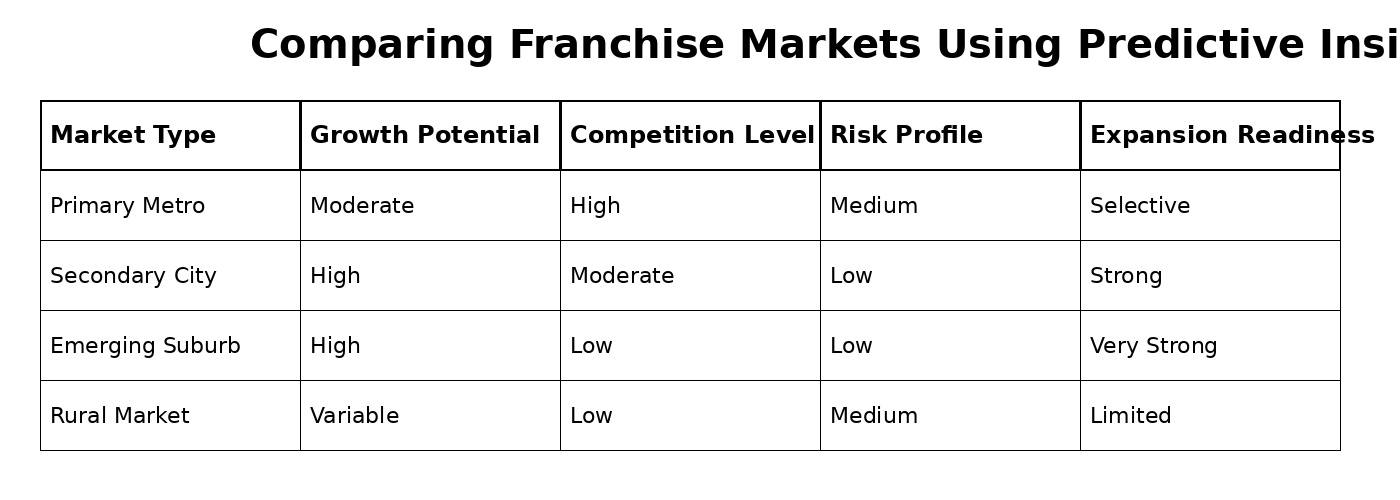
Comparing Franchise Markets Using Predictive Insights
This type of comparison illustrates how location intelligence for franchises supports clearer prioritization:
“Smart franchise growth starts with clarity. When brands rely on data instead of assumptions, they expand with confidence and protect the business they’ve worked so hard to build.” – Chris Conner, President of FMS Franchise.
This perspective reflects how FMS approaches franchise expansion planning, combining data insights with practical execution.
Common Questions About Data-Driven Growth
How does predictive analytics help choose a franchise location?
Predictive analytics evaluates historical data and market trends to estimate how a location is likely to perform before investment occurs.
Are data-driven franchise decisions better than traditional site selection?
They provide more insight and reduce risk, especially when combined with expert guidance.
Can small businesses benefit from predictive tools for franchise growth?
Yes. These tools help emerging brands prioritize markets and avoid costly expansion mistakes.
Do franchise consultant companies help interpret analytics?
Experienced consultants help ensure data is applied accurately and strategically.
Planning Franchise Expansion With Confidence
Choosing the right franchise location is one of the most consequential decisions a growing brand will make. Data-driven growth transforms that decision from a guessing game into a strategic process supported by evidence.
Predictive analytics offers clarity, but it works best when paired with experienced guidance. Franchise consultant companies help brands use data wisely, balance opportunity with risk, and expand in a way that supports long-term success.
If you are considering franchising or planning your next phase of expansion, now is the time to explore a smarter approach.
Contact us today to learn how predictive analytics can guide your franchise location strategy. Take the next step toward confident, data-driven expansion!
About the Author:
Chris Conner, President of FMS Franchise, brings over two decades of expertise in franchise development. Formerly Vice President at Francorp, he has worked with hundreds of franchise systems, specializing in franchise marketing, strategic planning, and system management. With a BS from Miami University and an MBA from DePaul University, Chris empowers business owners in the franchising process with tailored guidance and proven strategies. Connect with him on Linkedin.


