
Most founders who are ready to scale have no idea what they’re walking into when they hear the words “franchise registration.” They assume it’s a form or two. Maybe a fee.
Then reality sets in.
The franchise registration process involves federal rules, state-specific requirements, legal filings, disclosure documents, review timelines, and annual renewals – and getting any part of it wrong can stop your expansion before it even starts. For business owners who’ve spent years building something worth franchising, that’s a frustrating place to land.
But with the right guidance and the right team, this process is entirely manageable, and the franchisors who get it right build systems that hold up as they scale. Thousands of brands have gone through it successfully, and the ones that do it right build something that lasts. This post breaks down exactly how this process works in the U.S., what you need to know about different state categories, and where most first-time franchisors get tripped up. If you’re thinking about expanding through franchising, read this before you do anything else.
Understanding the Foundation: Federal Requirements First
Before getting into state-level complexity, it helps to understand what the federal government requires of every franchisor, regardless of where they plan to sell.
The FTC Franchise Rule and Why It Exists
The Federal Trade Commission (FTC) Franchise Rule is the baseline. Under it, any company offering franchises in the United States must prepare a Franchise Disclosure Document (commonly called the FDD) and provide it to every prospective franchisee at least 14 days before any contract is signed or any money changes hands.
What Is the Franchise Disclosure Document?
The FDD is a structured legal document covering 23 specific items required by federal law. It includes information about the franchisor’s background, litigation history, fees, financial performance, obligations of both parties, and the names and contact information of existing franchisees, among other things.
Preparing a compliant FDD is not a DIY project. It requires experienced franchise counsel and a clear understanding of your business model, financials, and operations. The document has to be accurate, complete, and updated regularly, since material changes to your business require updates to the FDD, and those updates can trigger additional filing obligations in certain states.
The Role of Trademark Registration
One thing that doesn’t get discussed enough in early franchise conversations is federal trademark status. Without a federally registered trademark, some states may treat your franchise offering as a business opportunity under separate (and often more burdensome) regulations. Getting your trademark house in order before you start the registration process can save significant time and cost later. FMS works with clients to ensure trademark status is addressed early in the development process, before state filings begin.
The Three Categories of U.S. States (And Why They Change Everything)
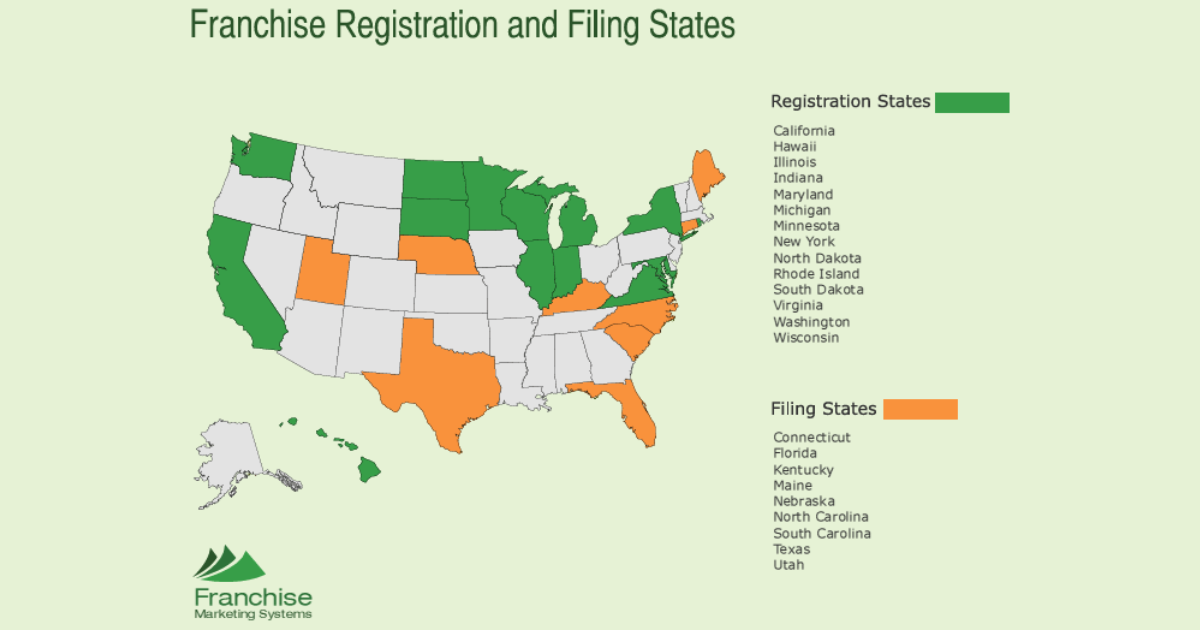
Once your FDD is in order, the next layer of complexity is state law. The U.S. doesn’t have a single unified franchise registration system – instead, each state falls into one of three categories, and your expansion strategy has to account for all of them. Here are the state guidelines:
Registration States
These are the states that require full registration of your FDD with a state regulator before you can legally offer or sell a franchise there. The regulator (often the Attorney General’s office or a state securities division) reviews your submission, may issue comments or request revisions, and ultimately approves (or declines to approve) your registration.
As of the current publicly available data, the registration states and their approximate initial filing fees are:
| State | Approx. Fee | Regulator / Notes |
|---|---|---|
| California | ~$1,865 | Dept. of Financial Protection & Innovation |
| Hawaii | ~$125 | Dept. of Commerce & Consumer Affairs |
| Illinois | ~$500 | Attorney General’s Office |
| Indiana | ~$500 | Secretary of State |
| Maryland | ~$500 | Office of the Attorney General |
| Michigan | ~$250 | State-level regulator review required |
| Minnesota | ~$400 | State-level regulator review required |
| New York | ~$750 | State-level regulator review required |
| North Dakota | ~$250 | State-level regulator review required |
| Rhode Island | ~$500 | State-level regulator review required |
| Virginia | ~$500 | State-level regulator review required |
| Washington State | ~$600 | State-level regulator review required |
| Wisconsin | ~$400 | State-level regulator review required |
Fees are approximate and subject to change. Always verify with the state regulator before filing.
Registration states also require annual renewals. That means each year, you’ll need to update your FDD (reflecting any material changes), pay renewal fees, and maintain your registration status. Letting a registration lapse in a state where you’re actively selling franchises creates serious legal exposure.
Filing States
Filing states occupy the middle ground. They require you to submit your FDD and pay a fee before offering franchises, but they don’t conduct the same substantive review that registration states do. Think of it as a notice requirement rather than an approval process.
Current filing states and their approximate fees include:
| State | Approx. Fee | Notes |
|---|---|---|
| Connecticut | ~$400 | Filing with Dept. of Banking |
| Florida | ~$100 / year | Annual notice under business opportunity law |
| Kentucky | $0 | Notice filing, no fee required |
| Maine | ~$25 | Notice filing required |
| Nebraska | ~$100 | Notice filing required |
| North Carolina | ~$250 / year | Annual filing required |
| South Carolina | ~$100 / year | Annual filing required |
| Texas | ~$25 | Notice filing required |
| Utah | ~$100 | Notice filing required |
Georgia and Louisiana may require additional filing if no federal trademark registration is in place.
The practical advantage of filing states is speed. Because there’s no substantive review, the process is faster and less costly. For franchisors in the early stages of expansion who want to begin building a franchisee base quickly, targeting filing states first is a reasonable strategy that FMS helps clients evaluate based on their goals and market fit.
Non-Registration States
The third category covers states that impose no state-specific registration or filing requirement beyond the federal FDD rule. In these states, if your FDD is federally compliant and you follow the 14-day disclosure rule, you can legally offer and sell franchises.
Examples include Alabama, Alaska, Arizona, Arkansas, Colorado, Delaware, Georgia, Idaho, Iowa, Kansas, Massachusetts, Mississippi, Missouri, Montana, Nevada, New Hampshire, New Jersey, New Mexico, Ohio, Oklahoma, Oregon, Pennsylvania, Tennessee, Vermont, West Virginia, and Wyoming.
But this doesn’t mean “anything goes” in non-registration states. State laws around business opportunities, unfair trade practices, and franchise relationship issues (like termination and renewal rights) still apply. But from a registration standpoint, your compliance burden is significantly lighter.
The Franchise Registration Process, Step by Step
Understanding the categories is important. But when it comes to actually executing, franchisors need to know what the process looks like on the ground. Here’s how it typically unfolds:
Step 1: Prepare or Update Your FDD
Everything starts here. If you don’t have an FDD, you need one. If you have one that’s outdated or was prepared without experienced franchise development counsel, it likely needs revision before it’s suitable for state submission.
This step takes longer than most people expect. Expect several weeks at minimum, and longer if your financials require an audit or if your business model is complex.
Step 2: Identify Target States and Their Classification
Once your FDD is ready, you need a clear picture of where you plan to sell franchises and what category each of those states falls into. This will impact your timeline, budget, and sequencing. Some franchisors start with non-registration states while simultaneously pursuing registration in higher-priority markets, while others focus registration efforts on one or two key states before expanding further.
Step 3: Submit Applications and Filings
For registration states, this means submitting the full FDD package: cover pages, state addenda, audited financials, any required exhibits, and the registration fee. Requirements vary by state, and even small errors in the submission can result in rejection or delay.
For filing states, the process is simpler: submit the FDD and pay the filing fee. In some cases, filing is only required if certain conditions apply (like the absence of a federally registered trademark).
Step 4: Navigate State Review (Registration States Only)
This is where franchisors in registration states often find themselves waiting — and sometimes going back and forth with state regulators on comments or required changes. Having experienced franchise counsel at this stage isn’t optional. A regulator’s comment letter isn’t a rejection, but responding to it poorly or slowly can extend your timeline significantly.
Step 5: Receive Registration or Acknowledgment
Once a registration state approves your submission, you receive formal approval to offer and sell franchises in that state. For filing states, receiving acknowledgment of your filing (or simply confirming the filing was accepted) is typically enough to proceed.
Step 6: Maintain Ongoing Compliance
Registration is not a one-time event. Annual renewals, FDD updates triggered by material changes, and renewal filings in both registration and filing states are recurring obligations. Building a compliance calendar (and assigning clear responsibility for maintaining it) is something FMS helps clients do from the start. Overlooking renewal deadlines is a surprisingly common problem, and the consequences range from administrative headaches to serious legal liability.
Common Mistakes and Strategic Considerations
There are a handful of decisions in the franchise registration process that seem minor at the time but have outsized consequences later. Understanding them upfront is part of what makes the difference between a smooth expansion and a difficult one.
Underestimating the Timeline
Registration states can take months to approve your FDD. If you’ve committed to a franchise sales timeline without accounting for state review cycles, you’ll find yourself legally unable to sell in markets you’ve already promised. So make sure to build in a buffer – lots of it.
Ignoring Annual Renewal Obligations
Many franchisors successfully register in multiple states and then let renewals slip – especially as their team grows and compliance responsibilities get diffused. A lapsed registration in a state where you’re actively selling isn’t just a paperwork problem. It can give franchisees grounds for rescission of their agreements and expose the franchisor to state enforcement action.
Skipping States to Save Money
It’s understandable to look at California’s ~$1,865 registration fee and the associated time investment and decide to skip it initially. That’s a legitimate strategic choice, as long as it’s deliberate and documented in your offer materials. The problem arises when franchisors don’t exclude these states clearly from their offer materials – or worse, accept interest from prospects in states where they’re not yet registered.
Trying to Do It Without Experienced Counsel
Franchise law is specialized. The FDD isn’t a template document, state regulators aren’t forgiving of errors, and the consequences of getting this wrong are real.
“The franchisors who struggle with registration are almost always the ones who tried to cut corners on legal and administrative preparation. Getting your FDD and state compliance right the first time is about building the kind of brand that franchisees trust and regulators respect.” – Chris Conner, President of FMS Franchise
Working with a team that understands both the legal and the strategic dimensions of franchise expansion is what separates franchisors who build strong networks from those who spend their first two years unwinding compliance mistakes.
FAQ About The Franchise Registration Process
How long does the franchise registration process take?
Timeline varies by state. Non-registration states have no approval process, so franchisors can move quickly after completing their FDD. Filing states typically process submissions without substantive review, so the timeline is short. Registration states involve a formal review process that can take anywhere from a few weeks to several months, depending on the state and the quality of the submission.
Do I need to register in every state before I can sell franchises?
No. You only need to register or file in states that specifically require it. Non-registration states only require that you have a federally compliant FDD and follow the 14-day disclosure rule. However, it’s critical to know which category each state falls into before accepting interest from prospective franchisees there.
What is the difference between a registration state and a filing state?
Registration states require a franchisor to submit their FDD for substantive review and receive formal approval before offering franchises. Filing states require submission and payment of a fee, but do not conduct the same level of review, making them faster and less costly to enter. Non-registration states require neither, as long as the franchisor maintains a federally compliant FDD and follows the 14-day disclosure rule.
What happens if I sell franchises in a registration state without approval?
The consequences can be severe. Franchisees may have the right to rescind their agreements, you may face state enforcement action or fines, and you risk being barred from enforcing the franchise contract in that state. This is why compliance planning before sales activity begins is non-negotiable.
How often does the FDD need to be updated?
The FDD must be updated annually and whenever a material change occurs. Material changes include things like significant litigation, changes to fees, changes in ownership, or new financial information. In registration and filing states, updates may trigger new filing obligations and fees.

Working with FMS Franchise
Franchise registration is detailed, state-specific, and legally consequential. For business owners who are ready to grow through franchising, the most important early decision is who guides you through this process.
FMS Franchise has supported hundreds of brands through franchise development – from the initial FDD preparation to state registration, ongoing compliance, and franchise sales strategy. Our team understands both the legal mechanics and the business strategy behind expansion, which means the guidance you receive is grounded in real-world experience, not just regulatory checklists.
If you’re exploring franchising as a growth model and want to understand what the registration process looks like for your specific business, the best first step is a conversation. Contact us today and find out what expanding your brand through franchising actually takes.
About the Author:
Chris Conner, President of FMS Franchise, brings over two decades of expertise in franchise development. Formerly Vice President at Francorp, he has worked with hundreds of franchise systems, specializing in franchise marketing, strategic planning, and system management. With a BS from Miami University and an MBA from DePaul University, Chris empowers business owners in the franchising process with tailored guidance and proven strategies. Connect with him on LinkedIn.


