
You’ve worked hard to build a business that works and now, the results speak for themselves: your model is proven, your customers are loyal, you’re on a roll! It’s time to grow – but where to?
For many entrepreneurs, expansion sounds like a leap of faith. You might know your business inside and out, but projecting how that success will translate to new markets can feel like guesswork. That’s where franchise data forecasting comes in – instead of expanding based on instinct, predictive analytics gives you a measurable, data-driven way to map future growth, evaluate potential markets, and refine your strategy with confidence.
At FMS Franchise, we help brands turn their data into direction using analytics, modeling, and strategic insight to identify the right markets, the right partners, and the right pace for sustainable expansion. Keep reading to learn how to turn numbers into a roadmap for scalable growth.
Why Predictive Analytics Matters in Franchising
Every successful franchisor eventually faces the same challenge: scaling without losing control. Growth is exciting, but it also introduces risks like market saturation and poor site selection or inconsistent franchisee performance.
Predictive analytics solves that problem by using your existing data to forecast what’s next. Instead of relying on historical averages or gut feelings, these models look at dozens of factors like demographics, income levels, consumer behavior, and even regional spending patterns, to reveal which territories are most likely to perform well.
This isn’t theory. It’s math in motion.
Predictive analytics franchises are already outperforming reactive ones by anticipating demand, optimizing resources, and reducing costly trial and error. When we implement forecasting tools for a client, we combine statistical modeling with real-world franchise experience – because numbers only matter when they’re tied to strategic action.
What Predictive Analytics Reveals
- Ideal market conditions: Which cities or regions have the right mix of demographics, spending power, and cultural alignment.
- Sales performance indicators: How pricing, promotions, and seasonality affect location performance.
- Franchisee fit: Using behavioral and operational data to identify who’s most likely to succeed – a key part of selecting the right franchisees for long-term growth.
- Operational efficiency: Where training, supply chain, or marketing support should be optimized for better returns.
When all these insights come together, franchisors gain a panoramic view of their growth potential. It’s no longer about hoping the next location works, but about understanding why it will.
Knowing the “why” behind your brand’s performance is only step one. The next phase is translating that insight into a strategy that actually guides expansion decisions.
Franchise Growth Modeling
Think of it as your roadmap for expansion. It takes everything predictive analytics reveals (from consumer demand to operational trends) and turns it into a concrete plan.
For many of our clients, this process starts with one question: How to scale without losing control?
We begin by examining each location’s performance metrics, customer demographics, and regional economics. Then, we create growth models that show what would happen under different scenarios, such as opening five units in mid-size cities vs. two in large metros.
The result is a data-driven blueprint that helps franchisors see the real-world impact of their choices before they commit.
We translate complex data into clear growth paths. For many clients, that means comparing a few scenarios side by side (urban flagship locations, suburban clusters, and regional multi-unit operations) to understand which model drives the best return and fits their brand vision.
Here’s what a simplified version of that comparison can look like:
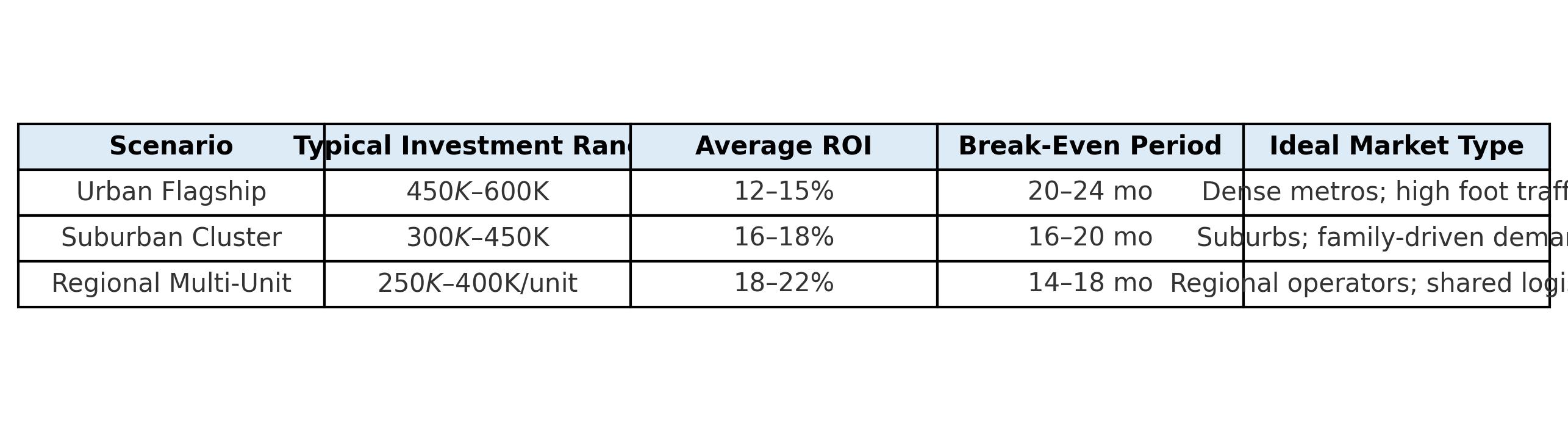
This snapshot gives a quick look at how franchise data forecasting supports smarter, evidence-based decisions. The numbers may shift depending on your industry and region, but the idea stays the same: by modeling scenarios before expanding, you can balance opportunity with risk.
Once your growth model is in place, the next step is integrating it into everyday planning.
Data-Driven Franchise Planning for Long-Term Success
Data by itself doesn’t build a franchise – people do. And when you combine strong leadership with accurate insights, growth becomes much more predictable.
Data-Driven Franchise Planning uses the insights from predictive analytics to guide decisions at every level of your organization, from site selection to franchise recruitment strategies and marketing investment. Here’s how we applied these insights to help one of our clients expand strategically and select franchisees that aligned perfectly with their brand vision:
Case Study: How Zambrero Found the Ideal Growth Markets
When Zambrero, an international fast-casual restaurant brand, partnered with us, their goal was clear: expand into new U.S. territories without losing the operational consistency that defined their success abroad.
Through franchise data forecasting, FMS analyzed market density, demographic patterns, and commuter flow data to identify regions where Zambrero’s core audience (suburban professionals and families with mid-to-high household incomes) was most concentrated.
These insights allowed the brand to prioritize high-potential suburban markets, tailor their marketing strategy to local dining habits, and select franchisees who already had strong community roots. The result was faster traction in new territories, higher early-stage revenue performance, and a scalable roadmap for sustainable growth across multiple regions.
“Franchising works best when it’s guided by evidence, not emotion. Predictive analytics gives our clients the confidence to scale at the right pace, in the right places, with the right partners.” – Chris Conner, President of FMS Franchise.
Even with the best models, franchisors still face challenges – from data integration issues to internal adoption. The good news is that those hurdles are fixable with the right systems and support.
Overcoming Challenges in Predictive Analytics Franchises
Let’s be honest: not every business has a clean database or a dedicated analytics team. Many small franchisors collect valuable data without realizing how useful it could be – from POS systems and CRM platforms to loyalty programs and franchise reports.
The biggest obstacle isn’t lack of information – it’s knowing how to interpret it.
Here are the most common challenges franchisors face when trying to implement predictive analytics franchises strategies and how we can help solve them:
1. Data Overload
The challenge: Too much unfiltered data from multiple sources.
FMS Solution: We consolidate and normalize your data so you can focus on what matters most: the trends that predict success.
2. Unclear KPIs
The challenge: Without clear performance indicators, even accurate data can mislead.
FMS Solution: We define measurable benchmarks tied directly to performance – the kind of franchise KPIs that drive growth, such as ROI per territory, average revenue per unit, marketing cost per acquisition, and more.
3. Lack of Technical Expertise
The challenge: Smaller brands may not have in-house analysts.
FMS Solution: Our franchise development team integrates forecasting tools into your existing franchise management systems, providing turnkey insights you can actually use.
4. Fear of Change
The challenge: Teams accustomed to instinct-based decisions may resist a data-driven shift.
FMS Solution: We provide hands-on training, simplifying technical terms and focusing on the business value behind the numbers.
5. Cost Concerns
The challenge: Predictive tools can seem expensive or unnecessary.
FMS Solution: We scale systems to your brand’s size and stage, ensuring you start with only what you need, then expand as you grow.
Our philosophy is simple: analytics should empower, not overwhelm. When data serves your strategy, franchising becomes not just scalable, but sustainable.
So how can franchisors actually apply forecasting in the real world? The answer lies in starting small, thinking strategically, and planning with intent.

Applying Franchise Data Forecasting in Real-World Scenarios
Forecasting doesn’t predicting the future perfectly, but it does dramatically improve your odds.
We teach clients to use forecasting as a living process, which means that data insights should evolve as your franchise does – the more information you collect, the more accurate your predictions become.
Here’s how to apply that principle across core areas:
Market Expansion
Predictive tools identify which territories have the right customer base and economic conditions. FMS helps you visualize potential hotspots for development and prioritize your rollout accordingly.
Franchisee Recruitment
Growth modeling highlights traits of top-performing franchisees, from experience level to investment capacity – so you can target candidates who mirror that success profile.
Marketing Optimization
Forecasting reveals which campaigns drive the highest conversion rates per market, allowing your marketing dollars to go further.
Operational Planning
By tracking performance trends, franchisors can plan staffing, inventory, and training resources before problems arise, instead of reacting afterward.
This is what makes predictive analytics so transformative. It turns uncertainty into clarity, helping brands scale strategically instead of impulsively.
To put it simply: when you combine analytics with our hands-on development expertise, you’re not just expanding. You’re building a franchise system that learns and grows with you.
Common Questions About Predictive Analytics and Franchise Growth
What kind of data is needed for franchise forecasting?
Operational data (sales, customer demographics, marketing costs), market data (population density, income, competition), and franchisee data (performance, investment level, training success).
Is franchise data forecasting only for large brands?
Not at all. Small and mid-size businesses benefit the most, because forecasting helps avoid early missteps that cost time and money.
How does predictive analytics help with global expansion?
By comparing data across global markets (from consumer spending to regulatory risk) forecasting models highlight where your brand is most likely to succeed in an international franchise expansion.
Does FMS provide ongoing data support?
Yes. FMS offers end-to-end support, from model setup to performance tracking, ensuring your forecasting remains accurate as your system evolves.
Is it expensive to implement predictive analytics?
It’s more affordable than most franchisors expect. The investment quickly pays for itself through smarter market selection and improved franchisee success rates.
The Future of Franchising Is Data-Driven
Franchising has always been about replication: repeating a successful model across new markets. But in today’s world, the brands that thrive aren’t just replicating – they’re adapting intelligently.
Franchise data forecasting makes that possible. It connects your history to your future, translating past performance into predictive clarity.
With FMS Franchise, you gain more than numbers. You gain a partner who knows how to turn analytics into action. From designing predictive frameworks to training your team and identifying new markets, our process helps you grow confidently, sustainably, and globally.
Because when your next move is guided by data (not guessing) every decision builds momentum.
Ready to plan your next move? Let’s turn your data into your competitive advantage. Contact us today to start building your data-driven franchise plan today.
About the Author:
Chris Conner, President of FMS Franchise, brings over two decades of expertise in franchise development. Formerly Vice President at Francorp, he has worked with hundreds of franchise systems, specializing in franchise marketing, strategic planning, and system management. With a BS from Miami University and an MBA from DePaul University, Chris empowers business owners in the franchising process with tailored guidance and proven strategies. Connect with him on Linkedin.


