


Have international buyers reached out about franchising your business? Congratulations! The opportunity is as real as all the questions that follow. In fact, many established brands attract overseas interest long before they feel ready to expand globally.
Selling franchises to international buyers is about knowing which opportunities are viable, which ones introduce unnecessary risk, and how to structure deals so growth stays controlled.
When done correctly, international franchising can be one of the most scalable and cost-effective ways to expand beyond domestic markets. This guide breaks down how international franchise expansion really work, what buyers are evaluating, and how to prepare your franchise system before moving forward.
Understanding How International Franchise Buyers Think
Selling franchises to international prospects begins with understanding how their mindset differs from domestic buyers.
Foreign buyers are rarely looking for a single unit. More often, they are operators or investment groups interested in area development or master franchise rights. In summary, their decisions are shaped by long-term regional growth, not short-term unit ownership.
What International Buyers Evaluate First
Most of these prospects focus on:
- Scalability within their home market
- Adaptability of the concept to local regulations and consumer behavior
- Strength and clarity of the franchisor’s systems
- Training, onboarding, and long-term support expectations
For many buyers, the brand itself is only part of the equation. The system behind the brand often matters more. So if processes are unclear or documentation is incomplete, confidence can erode quickly – even strong concepts can lose momentum at this stage.
Why Trust Plays a Larger Role in Global Franchise Sales
Unlike domestic buyers, international prospects cannot easily visit headquarters or speak casually with nearby franchisees. That means they rely heavily on what is documented and how professionally the opportunity is presented.
Clear franchise documentation, transparent financial assumptions, and structured support models reduce uncertainty and build credibility. And for many FMS clients, this realization becomes a turning point. International franchise sales succeed when preparation replaces improvisation.
So where should international growth actually begin?
Identifying High-Potential Markets for International Franchising
Interest alone is not a reliable indicator of opportunity. One of the most common mistakes brands make is reacting to inbound international inquiries without evaluating market fit. But successful global franchise expansion starts with market selection.
Key Market Selection Factors to Consider
When evaluating international franchise markets, several factors deserve close attention:
- Purchasing power and unit economics
- Local franchise regulations and disclosure requirements
- Cultural alignment with the brand experience
- Operational feasibility and supply chains
- Availability of experienced operators
A market may show strong consumer demand but lack qualified franchise operators. Another market may offer favorable regulations but require significant concept adaptation. In both scenarios, the risk is not obvious at the outset. This is why successful international franchising focuses on alignment across market demand, operator capability, and system integrity rather than chasing any single favorable signal in isolation.
Over time, challenges like these can create inconsistencies across the system, complicate training, and blur the brand’s identity across regions. And what looks like a promising market on paper can quickly turn into a support-heavy environment that strains the franchisor and frustrates franchisees.
Remember: the goal is alignment, not volume.
Common Regions for Selling Franchises Internationally
While every brand is different, several regions consistently attract franchise expansion:
- Middle East, where master franchise agreements are common
- Southeast Asia, driven by urban growth and emerging middle classes
- Latin America, where U.S. brands often carry strong recognition
- European markets with established franchising frameworks
Each region introduces different expectations around control, adaptation, and pace of growth.
Global Franchise Market Comparison
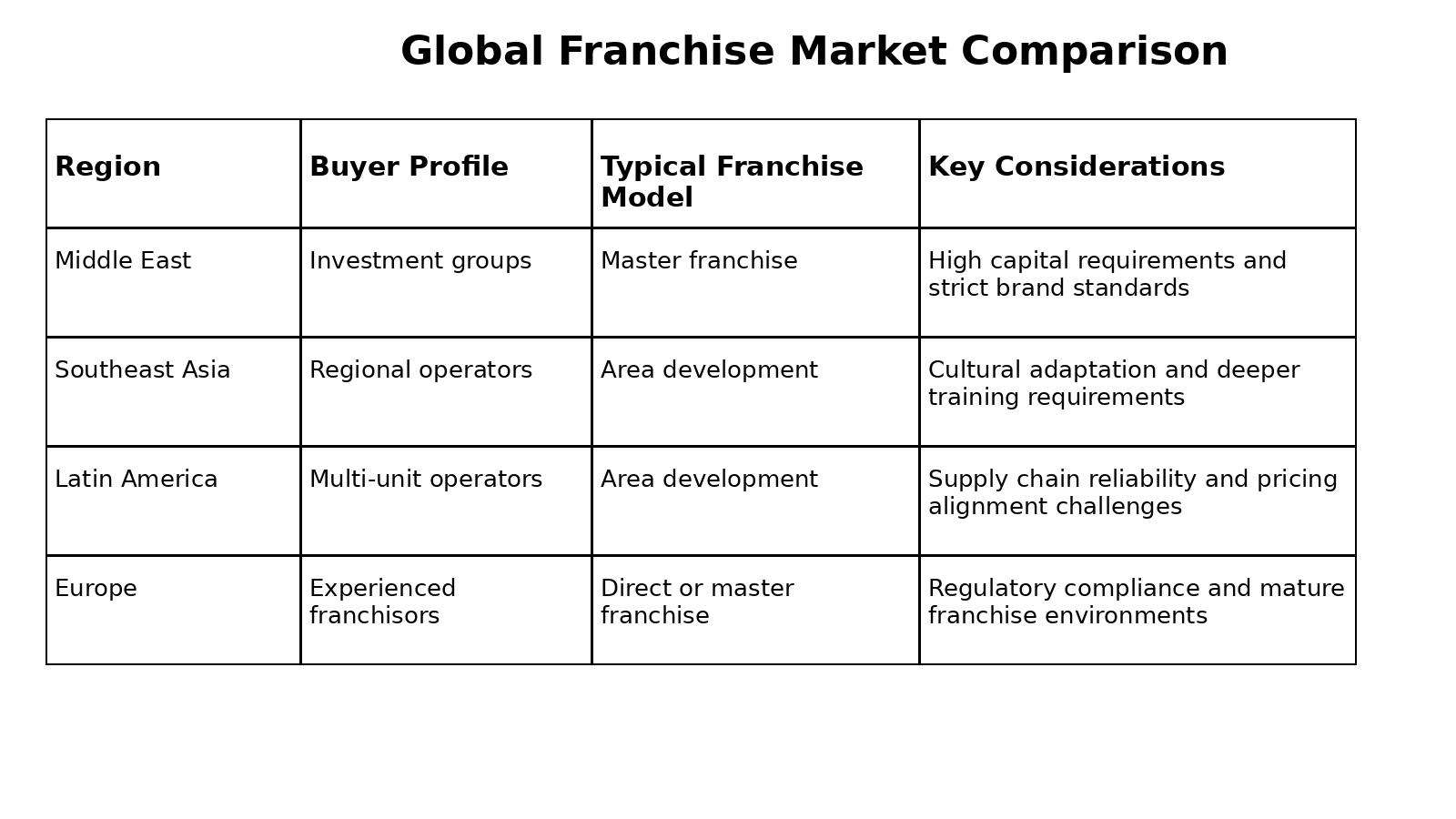
This kind of structured evaluation helps brands avoid entering markets based on enthusiasm rather than feasibility.
Once target markets are defined, attention should turn inward.

Preparing Your Franchise System for International Buyers
Selling franchises internationally exposes any weaknesses in a franchise system, and gaps that might be manageable domestically often become obstacles across borders.
The bottomline is – system readiness is not optional. Let’s explore how to prepare:
Franchise Documentation That Builds Buyer Confidence
International buyers expect clarity. This includes:
- Clearly defined brand standards
- Comprehensive franchise operations manuals
- Training programs adaptable to regional delivery
- Financial models that explain assumptions, not just outcomes
Well-organized documentation communicates professionalism and reduces friction during due diligence. Similarly, incomplete systems signal risk, even when the concept itself is strong.
Legal and Structural Readiness for International Franchise Sales
International franchising introduces legal considerations that vary by country. Disclosure rules, trademark protections, and agreement structures are not universal.
This does not mean brands need to launch everywhere at once. But it does mean each international agreement should be structured intentionally. FMS helps brands determine whether direct franchising, area development, or master franchising aligns best with the target market and the franchisor’s internal capacity.
Support Expectations Increase Across Borders
A common misconception is that international franchisees require less support. But in practice, expectations often increase.
International partners rely on the franchisor for:
- Training adaptation
- Brand consistency guidance
- Operational problem solving
- Market-specific adjustments
Clear preparation protects both sides. When support expectations, response times, and responsibilities are defined upfront, franchisors can scale confidently without compromising service quality. At the same time, international franchisees gain clarity around what support they will receive, when they can expect it, and where local responsibility begins. This reduces frustration, prevents misaligned assumptions, and creates a working relationship built on transparency rather than reactive problem-solving.
Once systems are in place, the focus shifts to how deals are structured.
Selling Franchises Internationally Without Losing Control
Fear of losing brand control stops many business owners from pursuing international franchising. That feeling is understandable – poorly structured agreements can create long-term challenges.
The solution is structure, not hesitation.
Structuring International Franchise Agreements
Effective documentation defines:
- Development timelines and performance benchmarks
- Brand adaptation limits
- Franchisee training programs and compliance requirements
- Renewal and termination conditions
These guardrails allow growth while maintaining consistency.
The Role of Master Franchise Models
For many brands, this model provides a practical balance between expansion and control. Instead of the franchisor supporting every individual unit across a foreign market, a master franchisee assumes responsibility for developing and managing the whole region.
This structure reduces operational strain on the franchisor by consolidating support and communication through a single, accountable partner. Rather than responding to dozens of unit-level issues across time zones, the franchisor works closely with one regional operator who understands both the brand and the local market.
When structured correctly, master franchise models create a scalable framework that allows international growth to move forward without overwhelming the franchisor or fragmenting the brand.
Why Experience Matters in International Franchise Development
International franchise sales shape the long-term trajectory of a brand. That means decisions made early can echo for years.
FMS brings experience helping brands structure, position, and sell franchises internationally with sustainability in mind. That experience helps clients avoid mistakes that only become visible after expansion begins.

Why FMS Supports Sustainable Global Growth
Selling franchises to international buyers is not about chasing every opportunity, but about building a system that attracts the right partners and filters out misalignment.
We help brands:
- Assess international readiness
- Identify high-potential global markets
- Structure franchise agreements strategically
- Build documentation that supports scalable growth
The result is expansion that feels intentional, not reactive.
“International franchising succeeds when brands focus on readiness instead of speed. Structure creates confidence for both franchisors and international partners.” – Chris Conner, President of FMS Franchise.
Frequently Asked Questions About Selling Franchises to International Buyers
Can small businesses sell franchises to international buyers?
Yes. System maturity matters more than size. Well-documented concepts with strong unit economics can succeed globally.
Do I need to expand into multiple countries at once?
No. Strategic entry into one or two aligned markets often produces better results than scattered expansion.
How long does it take to prepare for international franchising?
Preparation timelines vary, but structured planning upfront reduces delays and revisions later.
What are the biggest risks in international franchising?
Misaligned partners, unclear expectations, and underdeveloped systems are the most common risks. All can be mitigated with planning.
Turning International Interest Into Sustainable Franchise Growth
International franchising does not have to feel overwhelming. When approached thoughtfully, it becomes a controlled extension of a proven business model.
If international buyers are already reaching out to you, or if global expansion is part of your future plans, preparation makes the difference between hesitation and confidence.
Selling franchises to international buyers starts with clarity, structure, and the right guidance. Contact us today to move forward with confidence, and let’s franchise your business!
About the Author:
Chris Conner, President of FMS Franchise, brings over two decades of expertise in franchise development. Formerly Vice President at Francorp, he has worked with hundreds of franchise systems, specializing in franchise marketing, strategic planning, and system management. With a BS from Miami University and an MBA from DePaul University, Chris empowers business owners in the franchising process with tailored guidance and proven strategies. Connect with him on Linkedin.


