
Every successful small business reaches that exciting moment: demand is growing, customers are loyal, and expansion feels inevitable!
But how do you grow without losing what made your brand special in the first place?
That’s the dilemma many business owners face: franchising vs opening more locations. Both can drive growth and build brand recognition, but each path carries its own risks, rewards, and realities that every entrepreneur must weigh carefully.
At FMS Franchise, we help entrepreneurs across all industries find their best-fit growth model. Whether you run a single thriving food and beverage business or a fast-growing service brand, understanding the pros and cons of franchising for your business is essential before making the leap. Let’s dive in!
What Is Franchising?
To put it simply, franchising is a business growth model that allows independent entrepreneurs (franchisees) to operate their own locations under your established brand (franchisor), using your systems, trademarks, and proven business processes. In return, they pay fees and royalties, helping you expand faster while sharing operational responsibilities.
It’s a model built on replication and partnership. Your business becomes the blueprint for others’ success, which means you provide the playbook and franchisees bring capital, local insight, and hands-on management.
For many of our clients, this structure becomes a powerful way to grow beyond local limits. Instead of managing every new site themselves, they build a network of motivated owners who treat each location like it’s their own – because it actually is.
Benefits of Franchising for Business Owners
In addition to the benefits of franchisees being deeply invested in each unit’s success, Franchising delivers several key advantages that traditional expansion models can’t match:
- Shared Investment: Franchisees fund their own locations, reducing the financial risk for the franchisor.
- Faster Market Penetration: You can open multiple locations across cities or regions at the same time.
- Dedicated Operators: Franchisees are personally invested in success, ensuring high performance and accountability.
- Stronger Brand Presence: Each franchise location amplifies visibility and awareness.
- Scalability: Systems and processes can be replicated without proportional increases in overhead.
In short, franchising transforms your business from a single operation into a scalable system that is capable of growing across markets while maintaining brand consistency.
What Does Opening More Locations Entail?
Opening additional company-owned locations (the so often called corporate expansion) is the traditional way to grow. In this scenario, you maintain 100% ownership, full control, and direct oversight of every decision, from staffing to supply chains.
This model offers consistency, control, and heavy demands. Each new store requires significant upfront capital, new management layers, and continuous attention to operations. You’re responsible for everything: site selection, build-out, hiring, training, marketing, and more.
For businesses with strong internal infrastructure and deep financial resources, this can be effective. But for most small entrepreneurs, scaling through company-owned units can quickly strain cash flow and bandwidth.
Comparison of Control and Management
Here’s how business control and management differ between the two paths:
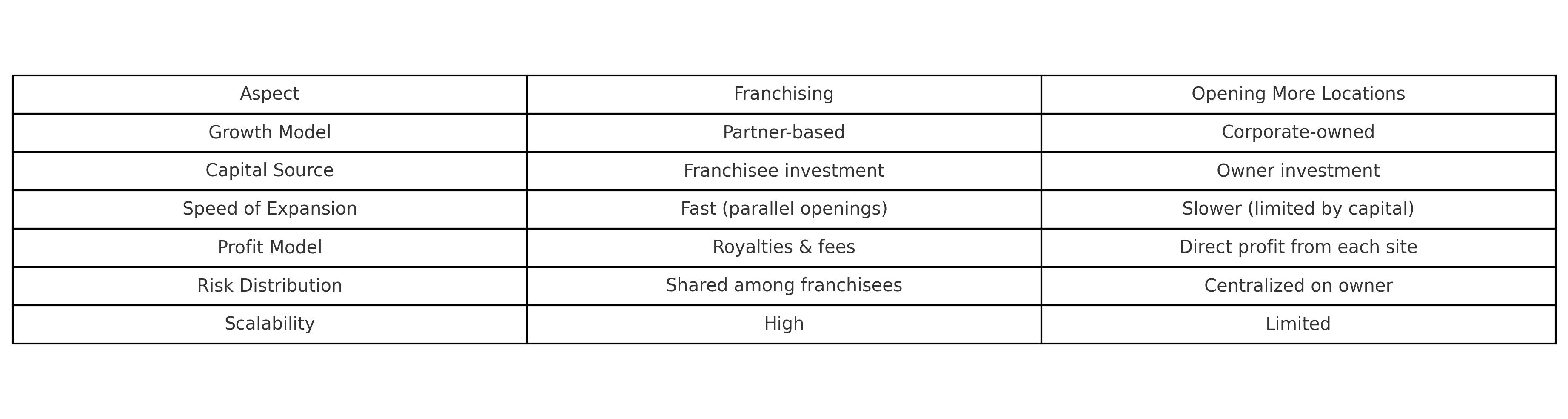
To summarize, franchising reduces direct control but multiplies business growth potential. Opening more locations keeps everything in-house but increases financial and operational pressure.
Franchising vs Opening More Locations
Both paths expand your footprint, but the business model behind each determines how fast, how far, and how profitably you can grow.
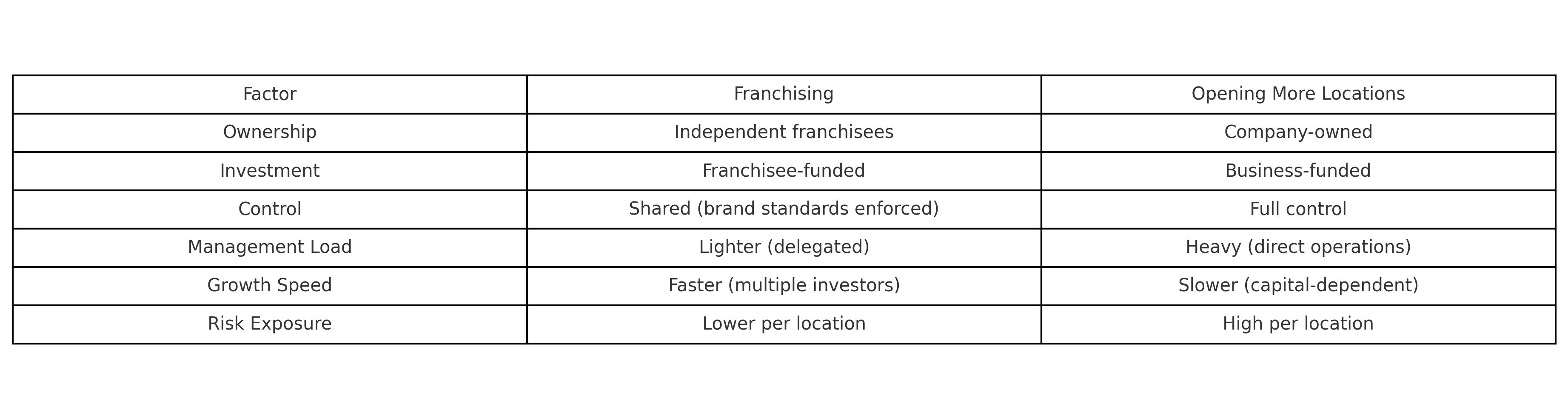
Franchising focuses on replication and on leveraging partners who invest in your model. Opening new locations depends on centralized management, relying solely on your internal resources.
When comparing, the biggest distinctions come down to capital, control, and scalability:
Pros and Cons of Both Options
Franchising Pros:
- Lower capital investment per location
- Rapid geographic expansion
- Motivated owner-operators
- Shared operational risk
- Increased brand awareness
Franchising Cons:
- Less direct control over daily operations
- Dependence on franchisee performance
- Requires strong training and compliance systems
Pros of Opening More Locations:
- Full control and ownership
- Direct profits from each unit
- Easier to maintain brand consistency
Cons of Opening More Locations:
- High capital and management requirements
- Slower growth rate
- Greater financial exposure
Financial Considerations for Each
Franchising requires upfront investment in development (legal documentation, training manuals, marketing systems), but these costs are one-time and often quickly offset by franchise fees.
Opening additional company-owned locations, by contrast, requires ongoing capital expenditures for every new build-out, lease, and staffing need. Over time, franchising can generate higher returns with less ongoing risk, especially when guided by a professional franchise expansion strategy.

Benefits of Franchising for Your Business
Franchising offers business owners a path to grow faster, reach new markets, and strengthen their brand without carrying the full weight of expansion alone.
Increasing Brand Presence
Every new franchise location strengthens your brand footprint. Instead of growing one store at a time, you’re creating local ambassadors who live and breathe your business values in their own markets.
That presence builds trust, recognition, and credibility faster than almost any advertising campaign could.
Accelerating Growth
Franchising allows expansion across multiple cities or states at once, since new franchisees invest in and operate their own units.
For many brands, this results in exponential growth, as each successful franchise opening attracts more inquiries, more leads, and more potential partners. At FMS Franchise, we’ve seen clients go from one location to twenty in just a few years through well-structured franchise systems designed for repeatability and sustainability.
Reducing Operational Burden
When you franchise, your role shifts from daily management to strategic leadership. Instead of running every store, you focus on guiding franchisees, refining systems, and building your brand.
For business owners ready to grow but tired of handling every operational detail, franchising creates freedom without sacrificing success.
“Franchising is about scaling smart. Our job is to help business owners replicate their success without losing what made them unique in the first place.” – Chris Conner, President of FMS Franchise.
Challenges of Franchising
Every growth path comes with challenges, and franchising is no exception.
Control and Quality Management
Maintaining consistent customer experiences across independently owned units requires strong systems, clear communication, and reliable training. This is why successful franchisors invest heavily in franchise manuals, onboarding programs, and brand audits – all services FMS helps develop and refine.
Legal Considerations and Costs
Franchising also involves legal requirements, like the Franchise Disclosure Document (FDD), state registrations, and compliance filings. Without professional guidance, these steps can be time-consuming and complex.
Partnering with an experienced franchising consulting company ensures your documentation, structure, and financial models meet federal and state laws, avoiding delays and costly revisions.
With FMS’s full-service franchise development approach, even complex legal and operational details become streamlined. Clients can focus on growth, knowing every foundation is built right from the start.

Franchising Consulting: Why You Need It
Many great businesses fail to franchise effectively not because their concept is weak, but because they try to do everything themselves.
A professional consulting partner helps you develop every piece of your model:
- Strategic Planning: Determine if your concept is franchise-ready.
- Legal Documentation: Build compliant FDDs and franchise agreements.
- Operations Manuals: Document your processes so franchisees can replicate your success.
- Marketing Support: Develop franchise recruitment strategies and materials.
- Financial Structuring: Define franchise fees, royalties, and ROI expectations.
FMS has guided hundreds of brands through this process, from emerging startups to established multi-unit businesses, helping them grow nationally and internationally.
The Role of Consulting in Business Expansion
Working with experts doesn’t merely simplify the process – it actually increases your odds of long-term success.
An experienced franchising consulting company ensures your systems are scalable, your financial model sustainable, and your franchisees well-prepared. They act as both architect and advisor, building a structure designed to grow while helping you avoid the pitfalls that stop many franchise systems before they even take off.
When you partner with FMS, you gain a dedicated team that helps you design a model for expansion, position your brand for the right markets, and recruit qualified franchisees aligned with your vision.
Choosing the Right Growth Path for Your Business
Every business is unique, and so is their growth strategy.
If you prefer full ownership and have the capital to expand slowly but steadily, opening more locations might suit your goals. On the other hand, if you want to scale faster, share the financial load, and build a brand that grows through others’ success, franchising may be the smarter move.
Here’s a quick summary:
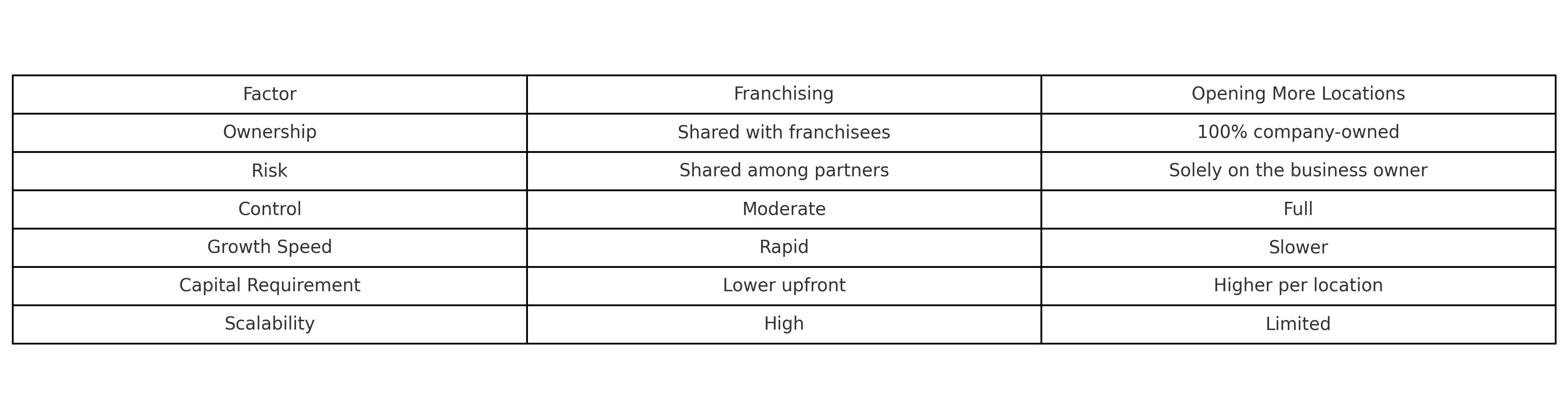
For many entrepreneurs, the turning point comes when they realize growth doesn’t have to mean giving up control, but to learn how to scale effectively.
Common Questions About Franchising and Expansion
When should I consider franchising my business?
When your business model is proven, profitable, and replicable. If you’ve built strong systems, brand recognition, and consistent results, franchising could be your next logical step.
What are the main costs involved in franchising?
Initial costs include legal documentation (like the FDD), training materials, and marketing support. With FMS, these are structured efficiently to minimize expense and maximize ROI.
How long does it take to set up a franchise system?
Typically between 90-120 days with professional guidance. Our structured process streamlines everything from legal setup to franchise sales readiness.
Can FMS help with global franchise expansion?
Absolutely. FMS has supported international franchise expansion across the Americas, Europe, and Asia, helping clients adapt their systems to new markets.
Why not just open more locations myself?
If you have the capital and team to manage growth, that can work. However, franchising lets you expand faster and reduce operational risk, often with greater long-term profitability.
The Right Path for Scalable Growth
Choosing between franchising vs opening more locations isn’t about which model is universally “better.” It’s about which one fits your business, goals, and resources best.
Franchising offers unmatched scalability, shared investment, and motivated owner-operators who believe in your brand as deeply as you do. Opening more locations gives you total control, but demands more time, money, and oversight.
At the end of the day, the smartest growth path is the one that aligns with your vision and ability to sustain it.
If you’re ready to explore franchising, or simply want expert advice on your next step, FMS Franchise is here to help. Contact us today for a free consultation and learn how our proven franchise expansion strategy can turn your business into the next success story.
About the Author:
Chris Conner, President of FMS Franchise, brings over two decades of expertise in franchise development. Formerly Vice President at Francorp, he has worked with hundreds of franchise systems, specializing in franchise marketing, strategic planning, and system management. With a BS from Miami University and an MBA from DePaul University, Chris empowers business owners in the franchising process with tailored guidance and proven strategies. Connect with him on Linkedin.