


Picture this: a local coffee shop owner sets her menu prices. She hopes those numbers will work all year, but mornings are packed, afternoons are quiet, and weekends are unpredictable. Customers either wait too long in line or the barista stares at empty seats during off-hours. That initial pricing felt safe, but now, revenue stays flat.
Now imagine that same shop using a dynamic pricing system: lattes cost a little more during the morning rush when demand peaks, but customer loyalty is rewarded with discounts mid-afternoon to fill empty hours. Suddenly, the shop’s earnings climb without raising costs, and franchise investors take notice.
This is what dynamic pricing franchises are discovering: with the right strategy, flexible pricing can transform a good business into a thriving system. The idea might feel daunting – after all, pricing is emotional, and customers don’t like surprises. But when done well, real-time pricing engines balance customer satisfaction with profit growth.
If you’ve ever wondered whether smarter pricing could unlock new growth in your franchise model, we can help you evaluate and implement the right system from day one. Let’s explore more in this article.
What Dynamic Pricing Means for Franchises
This isn’t a brand-new concept. Airlines, hotels, and rideshare companies have been using it for decades. But in the world of franchising, where consistency and brand trust matter, it’s only now gaining momentum.
At its core, dynamic pricing means adjusting prices in response to demand, timing, and other variables. For a franchise, that could mean charging more during peak hours, offering off-peak discounts, or tailoring prices by region.
From Fixed to Flexible
Traditional franchise pricing tends to be flat: one menu, one price, applied everywhere. It’s predictable, but not always profitable. For instance, a haircut at 9 AM on a Tuesday should not cost the same as one at 6 PM on Friday night when chairs are full. Fixed pricing leaves revenue on the table.
How Real-Time Pricing Engines Work
Modern real-time pricing engines track multiple data points, such as:
- Customer demand at certain times of day.
- Regional market trends.
- Seasonal fluctuations.
- Competitor pricing.
For franchises, this data doesn’t just set prices – it also creates growth patterns. With digital integration, the system adjusts automatically while keeping franchisees aligned with brand strategy.
Understanding what dynamic pricing is sets the foundation. The next step is evaluating its true impact on revenue.
Revenue Potential of Dynamic Pricing Systems
The promise of dynamic pricing is more than theory. From the health and beauty to the food and beverage industries, businesses see measurable revenue increases when they shift from static to flexible pricing. For franchises, the potential is even bigger, because a single change can scale across dozens (or hundreds) of locations.
Peak Hours and Premium Pricing
For most franchises, peak hours are predictable. A fast-casual restaurant might see a flood of customers between 11:30 AM and 1:30 PM, while a fitness center gets busiest after work. Customers already anticipate a wait during these times, which means modest price increases don’t feel unreasonable – they feel natural.
The benefit is twofold. First, it creates an immediate revenue bump during hours when demand is already strong. Second, it can subtly redirect price-sensitive customers to less busy times, balancing traffic across the day. For example, a sandwich franchise could raise prices slightly during the lunch rush while offering app-only coupons for late afternoon. The system doesn’t just charge more – it actively reshapes customer behavior to match capacity.
Off-Peak Discounts That Fill the Gap
The flip side of premium pricing is using discounts to bring energy into slower periods. No franchise operator wants to see empty seats, idle staff, or unused equipment, and dynamic pricing fills those gaps.
Picture a gym that offers discounted “off-peak” memberships, valid only between 9 AM and 3 PM. Retirees, freelancers, or flexible workers suddenly have a reason to choose that franchise over a competitor. Or consider a pizza chain offering half-price slices between 2 and 4 PM through its app. Those sales may not look like much in isolation, but across dozens of units, the cumulative lift is significant.
The key is strategy: discounts shouldn’t look like desperation. When framed as “exclusive offers” or “rewards for flexibility,” they strengthen the brand while generating revenue during downtime.
Bundling and Loyalty Tie-Ins
Dynamic pricing doesn’t stop at time-based adjustments – it becomes even more powerful when linked to franchise loyalty programs. By connecting flexible pricing with rewards programs, franchises can encourage repeat visits and deepen brand relationships.
For instance, an app-based coffee chain might offer standard prices to casual customers while loyalty members get exclusive off-peak discounts, bonus points, or bundle deals. Think: “Buy a latte at full price during the morning rush, get half off a pastry after 2 PM.” This approach makes customers feel valued for their loyalty while encouraging them to return at slower times.
Bundling also works across product categories. A salon franchise could charge standard rates for a Friday evening haircut but offer a reduced add-on for a midweek treatment. Customers perceive extra value, while the franchise increases average ticket size.
Revenue Impact of Dynamic Pricing Across Franchise Models
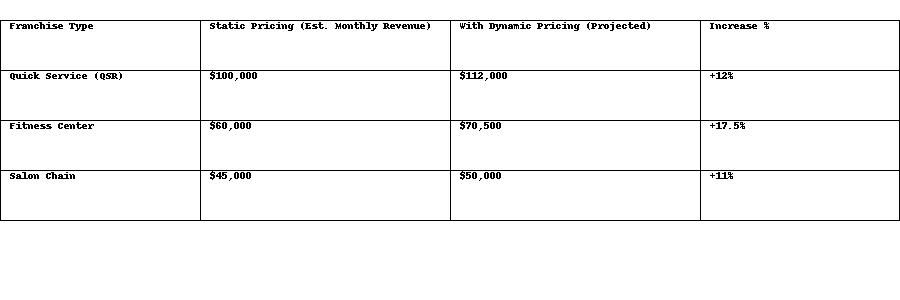
The numbers are promising, but adoption isn’t always simple. Let’s look at the obstacles franchises face with pricing systems.
The Challenges in Franchise Pricing
For all its potential, dynamic pricing isn’t a plug-and-play solution. Franchisors must navigate several challenges before rolling it out system-wide.
Balancing Brand Trust and Flexibility
Customers trust franchise brands because they know what to expect. Changing prices too often risks making them feel cheated. That’s why transparency is crucial – make sure to explain off-peak discounts as rewards, so that customers clearly understand that added value instead of getting confused.
Training Franchisees to Use Pricing Engines
Franchise owners vary in their comfort with technology. If a system feels confusing or inconsistent, franchisees may resist adopting it. Effective franchisee training programs and clear playbooks ensure alignment.
Global Expansion and Local Market Realities
When expanding internationally, franchise pricing becomes even more complex. Currency fluctuations, cultural differences in spending habits, and local competition all shape how customers perceive “fair pricing.” After all, what works in Chicago may fail in Seoul.
These challenges explain why expert guidance matters. Implementing dynamic pricing requires more than software – it demands strategy, structure, and support.
How FMS Helps Build Smarter Franchise Pricing Models
Here’s where we stand apart. Our role is to help franchisors test, refine, and implement dynamic pricing systems in ways that protect brand integrity while driving real growth.
Custom Franchise Pricing Strategies
No two franchises run on the same schedule – that’s why cookie-cutter pricing won’t cut it.
We begin with a deep analysis of your brand’s rhythm: What are the busiest hours? Which products or services sell best at different times? Where are customers most price-sensitive? By mapping demand cycles, reviewing competitor landscapes, and studying consumer behavior, FMS designs custom franchise pricing strategies that don’t just “raise prices”, but reshape how revenue flows throughout the day, week, and season.
The outcome is a system built for your franchise’s unique DNA, one that balances profitability with customer trust.
Evaluating Global Markets for Price Sensitivity
Pricing strategy gets even more complex when franchisors look beyond borders. A price point that works in Dallas may feel steep in Mexico City or modest in Dubai. Cultural expectations, exchange rates, and average buying power all play a role.
That’s where FMS steps in. We evaluate markets with data-driven insights, measuring income levels, local competition, and even consumer psychology. For example, in some cultures, customers see discounts as an exciting incentive. In others, constant markdowns may signal low quality.
By tailoring franchise pricing to each market’s reality, franchisors protect brand perception while maximizing revenue potential. Instead of one global standard, FMS helps design flexible guidelines that keep franchises competitive, fair, and scalable worldwide – laying the groundwork for successful international franchise expansion.
Integrating Real-Time Pricing Engines into Operations
Even the best pricing model fails without proper execution. Technology is powerful, but software on its own can’t solve the bigger challenge: making sure franchisees adopt it consistently.
FMS takes a holistic approach. Beyond recommending a real-time pricing engine, we connect it with your franchise operations. That includes:
- Training programs so franchisees know when and why prices adjust.
- Support systems to answer questions and troubleshoot adoption hurdles.
- Operational playbooks that tie pricing changes to customer experience, marketing campaigns, and loyalty programs.
This integration makes pricing systems sustainable long-term. Franchisees feel supported, customers see transparency, and franchisors get reliable revenue lift without undermining brand trust.
“Dynamic pricing works when it’s framed as customer value, not just higher margins. Our role is to help franchisors strike that balance.” – Chris Conner, President of FMS Franchise.

Common Questions About Dynamic Pricing
Will customers feel like they’re being overcharged?
Not if the strategy emphasizes value. Discounts during off-peak hours and loyalty rewards make dynamic pricing feel like a win for the customer.
Can franchisees control pricing locally?
Yes, within boundaries. Most systems allow franchisors to set guidelines while letting local operators adjust within ranges.
What industries benefit most?
Quick service restaurants, gyms, entertainment venues, and salons see the fastest results, but any franchise with fluctuating demand can benefit.
How does this affect brand reputation?
Handled poorly, it can create mistrust. Handled well, it builds loyalty, because customers see dynamic pricing as fair and responsive.
Bringing Dynamic Pricing Into Your Franchise Future
The takeaway is simple: dynamic pricing franchises aren’t just chasing revenue – they’re building smarter, more resilient growth models. By adapting prices in real time, brands can align with customer demand, improve profitability, and prepare for global expansion.
The key is execution. Without structure, pricing systems can backfire. With FMS, franchisors get expert support, tested strategies, and seamless integration into their franchise model.
If you’re considering whether dynamic pricing could fuel your franchise growth, let’s talk. Contact us today to build a pricing model designed for both revenue and customer trust.
About the Author:
Chris Conner, President of FMS Franchise, brings over two decades of expertise in franchise development. Formerly Vice President at Francorp, he has worked with hundreds of franchise systems, specializing in franchise marketing, strategic planning, and system management. With a BS from Miami University and an MBA from DePaul University, Chris empowers business owners in the franchising process with tailored guidance and proven strategies. Connect with him on Linkedin.


