
If you are considering international expansion, you have probably had this thought:
‘What if expanding overseas damages everything we have built?’
It is a fair concern. You have spent years refining your operations, protecting your brand, and earning customer loyalty. Stepping into a new continent, with unfamiliar regulations and new cultural expectations, can feel like an enormous risk.
But when planned properly, choosing to franchise your business in Europe can be one of the most strategic moves you ever make. It allows you to scale without the capital burden of company-owned expansion while maintaining operational standards and brand integrity.
If that thought has crossed your mind, this is your starting point. Let’s walk through what that structure looks like.
Why Europe Is a Strategic Move for Franchise Growth
Europe is not a single market – it is a collection of distinct economies, each with its own consumer behavior, legal framework, and business culture.
That complexity can feel intimidating, but it also creates opportunity.
Across the continent, this business model is well established. According to the European Franchise Federation, franchising accounts for thousands of brands and hundreds of thousands of franchisees across member countries.
For established business owners in North America, this presents three advantages:
- Strong investor familiarity with franchising
- Established franchise exhibitions and recruitment channels
- Consumers who are comfortable with structured, branded systems
At the same time, Europe rewards discipline. That means entering without adapting to local expectations can quickly stall growth. A concept that performs well in Texas may require pricing adjustments in Spain, for example. And a service model built around extended business hours may need to adjust for labor regulations in France, for instance.
This is where strategic European franchise growth becomes critical.
Rather than asking whether Europe is attractive, the better question is whether your business is ready for structured international replication. That leads directly into the legal and regulatory foundation that supports sustainable growth.
Understanding Franchise Laws in Europe
One of the most common misconceptions business owners have when exploring international expansion is assuming that European regulations work the same way as those in the United States.
They do not.
There is no unified EU-wide franchise law governing the entire region; instead, each country regulates franchising independently. That means the legal framework must be evaluated on a country-by-country basis.
Let’s break down the key legal elements involved in European franchise expansion.
Country-Specific Franchise Regulations
Unlike the U.S., where the rules apply nationwide, European countries regulate franchising independently. Some markets have dedicated franchise legislation, while others rely on broader commercial or competition laws.
For example:
- France requires pre-contract disclosure under the Loi Doubin regulations.
- Italy mandates disclosure documentation and franchise agreements written in Italian.
- Spain requires franchisors to register with a national franchise registry.
- Belgium enforces strict pre-contract information rules designed to protect franchisees.
- Germany does not have a standalone franchise law but relies heavily on commercial and competition law principles.
For business owners, this patchwork of regulations means expansion cannot follow a single standardized legal template – every market must be evaluated individually.
Franchise Disclosure Requirements Across Europe
Another major difference involves disclosure documentation.
Many European countries require a disclosure document similar to a U.S. Franchise Disclosure Document, but the structure and requirements vary.
Common disclosure elements include:
- Company background and ownership structure
- Financial information about the franchisor
- Initial investment and ongoing fees
- Intellectual property rights
- Franchisee obligations and operational expectations
- Market and competition disclosures
Because these requirements differ by jurisdiction, your strategy must be tailored to each country. Using a single document across multiple markets rarely works without significant legal adaptation.
Why Legal Preparation Matters More Than Speed
Many founders underestimate how long international compliance takes. Others assume they can translate their U.S. Franchise Disclosure Document and move forward.
That shortcut often leads to complications. Agreements may not meet local standards, disclosures may be incomplete, and intellectual property protections may not align with regional law.
At FMS Franchise, we work with international legal partners to ensure European requirements integrate smoothly with your existing franchise systems. Here, international compliance is not treated as an afterthought – it is treated as the foundation of sustainable global growth.
Once that legal groundwork is secure, the next priority becomes the structure of your entry into Europe.
Choosing the Right Structure for European Franchise Expansion
International growth is not one-size-fits-all. The structure you choose will influence control, capital requirements, and long-term scalability.
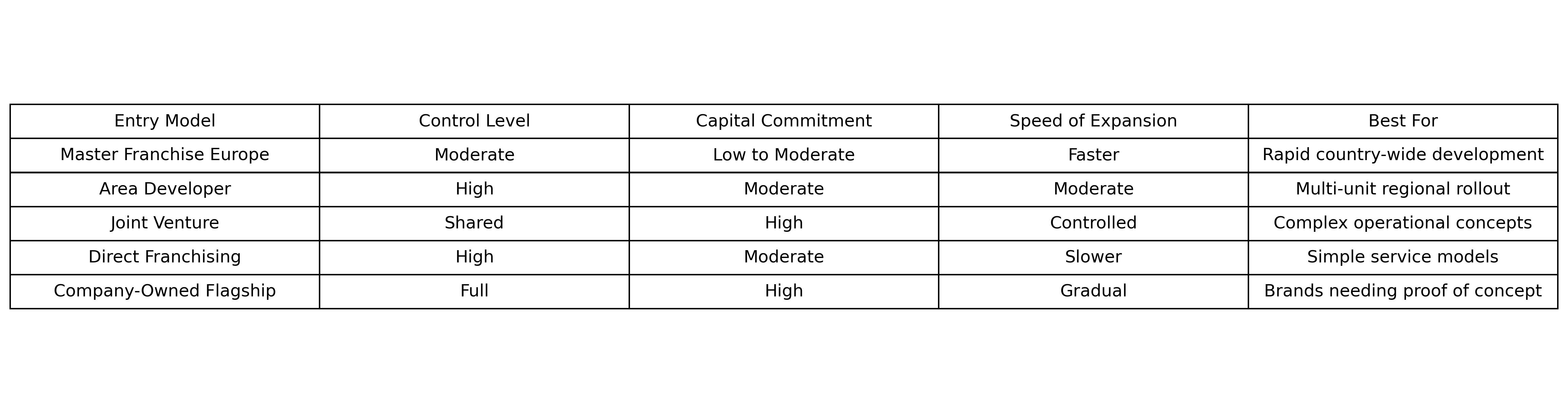
Below is a comparison of common entry models used in master franchise Europe strategies and broader European rollout.
European Market Entry Model Comparison
In short:
- The structure of a master franchise for Europe allows a local partner to develop and sub-franchise within a country, which reduces your operational burden but requires careful partner selection.
- Area development agreements provide more oversight but often require more direct involvement.
- Joint ventures are effective for highly regulated or operationally complex concepts.
For many small business owners, the challenge is determining which model aligns with their appetite for involvement and financial risk – this is where strategy matters more than enthusiasm.
“International expansion only works when structure leads the vision. Growth without structure creates exposure – you need it to create enterprise value.” – Chris Conner, President of FMS Franchise.
Once the structure is chosen, the next critical piece is operational adaptation.
Adapting Your Model for European Consumers and Operations
This is often the stage where international expansion becomes real.
You probably already understand that a concept performing well in North America will not automatically translate into success in Europe. This transition requires thoughtful adjustments across operations, pricing, and the overall customer experience so the model fits local expectations and market realities.
To understand what that looks like in practice, it helps to break the process down.
Consumer Behavior and Cultural Expectations
European customers often interact with brands differently than North American consumers.
Dining schedules provide a simple example. In Spain, dinner frequently starts around 9 or 10 PM, so restaurants that close earlier may miss a significant portion of the evening demand.
Cultural preferences also influence purchasing decisions. In countries such as Germany and the Netherlands, sustainability and responsible sourcing carry significantly more weight than in other regions. That means consumers may actively research where products come from and how they are produced.
For franchisors entering Europe, success often depends on recognizing these patterns early and aligning the customer experience accordingly.
Regulatory and Labor Considerations
Operational planning must also account for the labor environment.
Common labor requirements across many European markets include:
- Mandatory paid vacation
- Maximum weekly working hour limits
- Strong termination protections
- Collective bargaining structures in some industries
If your franchise model relies heavily on flexible labor scheduling or extended operating hours, financial modeling will need to account for these realities.
Understanding these factors early helps prevent operational friction after launch.
Product Standards and Supply Chain Differences
Product standards can vary across Europe, particularly in industries such as food service, cosmetics, and health-related products.
Ingredient labeling rules, sourcing requirements, and safety regulations vary by country within the EU framework.
These variations may affect:
- Product formulation
- Packaging and labeling standards
- Import procedures and duties
- Local sourcing partnerships
Many franchisors find that building relationships with regional suppliers or distribution partners significantly simplifies this process.
Careful supply chain planning ensures the brand experience remains consistent while complying with local regulations.
Once the model is legally compliant, structurally aligned, and culturally adjusted, the focus shifts to identifying the right franchise partners and supporting long-term growth in the region.

Building Strong European Partnerships
Europe values credibility and relationships, so franchise recruitment often occurs through:
- Regional franchise exhibitions
- Local brokers and consultants
- Investor networks
- Country-specific franchise portals
And European investors look carefully at:
- Brand maturity
- Unit economics
- Leadership credibility
- Support systems
- Long-term commitment
They want to see that your brand is not experimenting internationally. They want evidence of operational discipline.
At FMS, our role extends beyond documentation. We help position your brand effectively within European investor channels, ensuring that messaging aligns with market expectations. We also guide partner vetting, which is arguably the most critical component of master franchise arrangements in Europe.
A misaligned partner can stall expansion for years. A qualified partner can significantly accelerate enterprise value, but that balance requires patience.
Step-by-Step Roadmap to Franchise Your Business in Europe
For clarity, here is a structured sequence we use when helping clients franchise your business in Europe.
- Assess international readiness and replicability
- Conduct trademark search and EUIPO filings
- Develop country-specific franchise disclosure documentation for Europe
- Localize franchise agreements
- Adapt operations manuals and training materials
- Refine financial modeling for European labor and cost structures
- Select market entry structure
- Identify and vet local partners
- Launch pilot or flagship operations
- Scale gradually, country by country
For brands considering international growth, working with advisors who understand both North American franchise structures and European compliance frameworks can significantly reduce risk.
The team at FMS Europe focuses specifically on helping brands prepare for European franchise expansion, from legal structuring to partner recruitment.
Each stage builds upon the previous one. Remember that skipping steps creates friction later.
Frequently Asked Questions
Can I use my U.S. Franchise Disclosure Document in Europe?
No. European countries require country-specific disclosure and legal adaptation. A translated U.S. FDD is usually insufficient and may not meet local compliance standards.
How long does it take to franchise your business in Europe?
Most structured expansions take 9 to 18 months from legal preparation to first unit launch. Timelines vary based on market selection and trademark clearance.
Is a master franchise Europe model the best option?
It depends on your goals. Master franchise agreements allow faster scaling with local partners but require strong vetting and structured oversight.
Do I need an EUIPO trademark before recruiting franchisees?
Yes. Trademark protection should be secured before marketing or signing agreements to avoid legal disputes and brand limitations.
Is European franchise expansion expensive?
Costs vary by country and structure. While legal and localization expenses are significant, franchising remains more capital-efficient than company-owned international expansion.

The Opportunity and the Discipline Required
Europe offers meaningful opportunities for brands ready to expand beyond domestic markets. But it also demands discipline.
When business owners approach European franchise expansion with a structured mindset, strong legal preparation, and the right partnerships, the results can redefine the trajectory of the company.
For many clients, this step transforms a regional brand into an international enterprise.
At FMS Franchise, our role is to remove uncertainty from that process. We provide legal coordination, strategic structuring, financial modeling, partner recruitment guidance, and long-term expansion planning.
If you are evaluating whether to franchise your business in Europe, the next step is not guessing.
It is planning.
If you are ready to evaluate whether your business is positioned for European expansion, speak with an FMS franchise strategist. The first step is not a commitment; it is a conversation.
About the Author:
Chris Conner, President of FMS Franchise, brings over two decades of expertise in franchise development. Formerly Vice President at Francorp, he has worked with hundreds of franchise systems, specializing in franchise marketing, strategic planning, and system management. With a BS from Miami University and an MBA from DePaul University, Chris empowers business owners in the franchising process with tailored guidance and proven strategies. Connect with him on LinkedIn.